XOpsSchool.com: A Practical Learning Guide for Modern IT Operations

September 15, 2026 · 18 reads
Introduction
Technology teams now manage far more than application deployment and server maintenance. Cloud infrastructure, automation, data engineering, artificial intelligence, machine learning, cybersecurity, monitoring, and reliability all contribute to successful digital operations. As these areas continue to connect, professionals need skills that extend beyond one technical specialization.
XOpsSchool.com provides a learning-focused approach to this changing environment by bringing together concepts from multiple operational disciplines. Its knowledge areas cover XOps Training, XOps Certification, XOps Course, practical XOps Tutorial content, and information about XOps Tools. Learners can also explore DevOps Training, AIOps Training, MLOps Training, and DataOps Training to understand how specialized practices fit into the larger XOps ecosystem.
For beginners, understanding What is XOps provides a useful starting point. For experienced professionals, the concept offers a way to connect existing skills with broader operational responsibilities.
XOps Training: Develop Skills Across Connected Technology Operations
Learning modern operations requires more than understanding individual tools. Professionals need to know how development, infrastructure, data, artificial intelligence, security, and reliability influence one another. XOps Training can provide this broader perspective by connecting common operational principles across different technology functions.
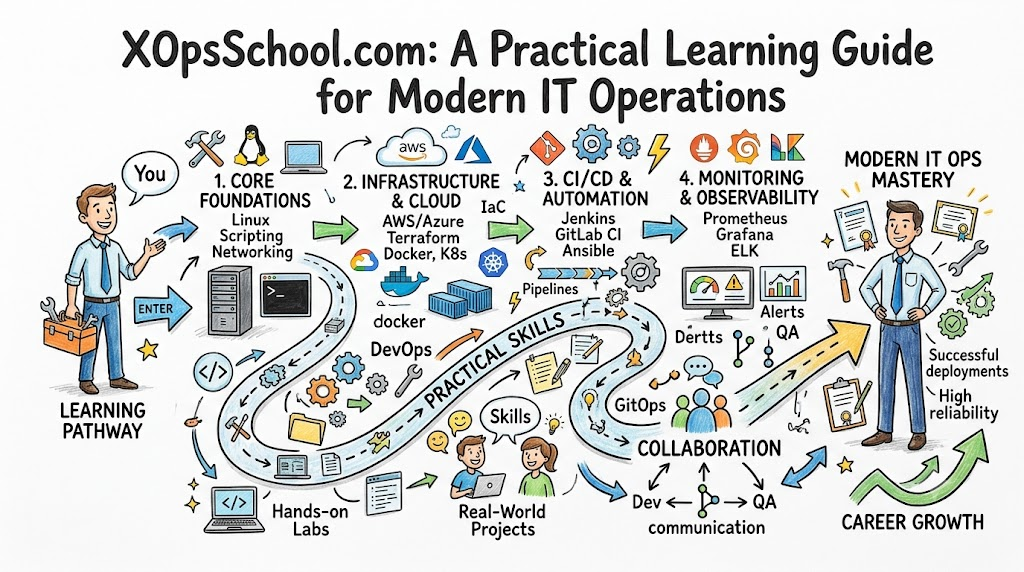
A sensible learning path should begin with fundamentals. Learners can first develop knowledge of Linux, networking, Git, scripting, cloud computing, containers, and automation. After establishing those foundations, they can move into CI/CD, Kubernetes, infrastructure as code, monitoring, observability, DataOps, MLOps, and AIOps.
A practical XOps learning program should emphasize:
- Automation instead of repetitive manual processes
- Collaboration between technical teams
- Continuous integration and delivery
- Infrastructure consistency
- Monitoring and observability
- Security throughout operational workflows
- Reliable data movement
- Machine learning lifecycle management
- Intelligent incident analysis
- Continuous improvement
Real experience also matters. A learner who builds a small automated deployment environment can understand operational challenges much better than someone who only memorizes definitions.
Therefore, practical projects, troubleshooting exercises, architecture examples, and hands-on labs should form an important part of XOps learning.
XOps Certification: Demonstrate Knowledge Beyond Individual Technologies
Professionals often use certification to organize their learning and demonstrate technical knowledge. XOps Certification can support that objective when learners combine examination preparation with practical experience.
Certification preparation should cover concepts rather than encourage memorization. Learners should understand why teams use automation, how observability supports troubleshooting, how cloud infrastructure affects application delivery, and how specialized operational practices connect.
Professionals can strengthen their preparation by creating practical scenarios around:
- Automated application deployment
- Infrastructure provisioning
- Container management
- Monitoring and alerting
- Data pipeline operations
- Machine learning deployment
- AI-assisted incident analysis
- Security and governance
- Reliability engineering
A certification alone does not establish complete professional capability. However, structured preparation can reveal knowledge gaps and encourage learners to study areas outside their existing specialization.
For example, a DevOps engineer may already understand CI/CD but need stronger knowledge of machine learning lifecycle management. Similarly, a data engineer may understand pipelines but want to learn more about infrastructure automation and observability.
This cross-functional learning represents one of the strongest benefits of an XOps-oriented approach.
XOps Course: Create a Progressive Roadmap for Technical Growth
An effective XOps Course should guide learners from basic concepts toward practical implementation. Without a clear progression, newcomers may encounter too many technologies at once and struggle to understand how they relate.
The learning journey can begin with foundational infrastructure and software engineering concepts. Learners can then study automation, cloud platforms, containers, orchestration, CI/CD, infrastructure as code, observability, and reliability.
After building that foundation, specialized modules can introduce DataOps, MLOps, AIOps, SecOps, FinOps, and platform engineering.
A useful course should combine several learning formats:
- Short conceptual explanations
- Practical demonstrations
- Hands-on exercises
- Troubleshooting scenarios
- Real-world use cases
- Tool comparisons
- Architecture discussions
- Project-based assignments
Course quality also depends on how well it explains trade-offs. Every technology has advantages and limitations. Learners should understand those differences before selecting a tool for a production environment.
This approach creates stronger decision-making skills and helps professionals move from simply knowing technology names to understanding when and why organizations use them.
XOps Tutorial: Learn Through Real Problems and Practical Examples
A good XOps Tutorial should answer practical questions instead of simply presenting commands or definitions. Learners understand technical subjects more effectively when tutorials connect concepts to problems they may encounter at work.
For example, consider a team that deploys applications manually. The tutorial can explain how version control, automated testing, CI/CD, containers, infrastructure as code, and monitoring can gradually improve that workflow.
A similar method can explain other XOps disciplines. A DataOps tutorial can begin with inconsistent data pipelines. An MLOps tutorial can examine model deployment and performance monitoring. An AIOps tutorial can focus on excessive alerts and event correlation.
For strong AEO, GEO, LLMO, and AISEO, educational content should answer questions clearly and organize information around user intent. Direct definitions, practical examples, comparison points, step-by-step explanations, and concise answers make technical information easier for both readers and modern search systems to interpret.
A useful tutorial can follow this sequence:
- Identify the operational problem.
- Explain the relevant concept.
- Introduce appropriate technologies.
- Describe the implementation process.
- Discuss common challenges.
- Explain how teams measure results.
- Recommend practical improvement steps.
This format encourages learning through application rather than passive reading.
XOps Explained: Understanding the Broader Operations Framework
To understand What is XOps, start with the idea of connected operations. XOps acts as an umbrella concept for operational practices that manage different parts of a technology environment.
DevOps connects software development and operations. DataOps applies operational discipline to data delivery. MLOps manages machine learning systems throughout their lifecycle. AIOps applies intelligent techniques to operational information. SecOps connects security with technology operations, while FinOps focuses on financial accountability for technology resources.
XOps brings these areas into a broader perspective.
Consider a company that runs a cloud application supported by analytics and machine learning. The application team may use DevOps for delivery, the data team may use DataOps for pipelines, the machine learning team may use MLOps for models, and the operations team may use AIOps for event analysis.
Each discipline has its own responsibilities, but they also share common goals:
- Automation
- Reliability
- Visibility
- Collaboration
- Governance
- Scalability
- Continuous improvement
That shared foundation explains why XOps has become a useful way to discuss modern operational practices.
XOps Tools: Choose Technology According to the Problem
The technology landscape contains a large number of XOps Tools, but professionals should avoid choosing tools simply because they appear popular. The right selection depends on workload requirements, existing infrastructure, team expertise, integration needs, security requirements, and budget.
Common technologies support different stages of the operational lifecycle. Version-control platforms manage code and configuration. CI/CD systems automate software delivery. Infrastructure-as-code tools help teams create repeatable infrastructure. Container platforms package applications, while orchestration systems manage distributed workloads.
Monitoring and observability technologies provide visibility into application and infrastructure behavior. Data orchestration tools coordinate pipelines, while machine learning platforms support model lifecycle activities.
| XOps Area | Main Purpose | Example Technologies |
|---|---|---|
| Source Control | Manage code and configuration | Git |
| CI/CD | Automate build, test, and delivery | Jenkins and similar platforms |
| Infrastructure as Code | Automate infrastructure | Terraform |
| Containers | Package applications | Docker |
| Orchestration | Manage container workloads | Kubernetes |
| Monitoring | Track system health | Prometheus |
| Visualization | Analyze operational information | Grafana |
| Data Orchestration | Coordinate data pipelines | Airflow |
| MLOps | Manage machine learning workflows | MLflow |
| Cloud Operations | Run scalable infrastructure | Cloud platforms |
This table provides a starting point rather than a universal technology stack. Organizations should evaluate tools according to their actual operational requirements.
DevOps Training: Establish the Core Skills Behind XOps
Many professionals begin their XOps journey through DevOps Training because DevOps introduces several practices that appear throughout modern operations.
Learners can study version control, continuous integration, continuous delivery, infrastructure automation, containerization, orchestration, cloud computing, monitoring, and security. These skills create a strong foundation for exploring additional XOps disciplines.
A practical DevOps learning journey should connect each technology to an operational objective.
Git supports controlled collaboration and change management. CI/CD reduces manual delivery work. Containers improve application consistency. Kubernetes helps teams manage containerized workloads at scale. Infrastructure as code supports repeatable infrastructure changes. Observability helps engineers understand system behavior.
A real-world learning project could combine these concepts into one workflow. A learner might store application code in version control, automatically test changes, build a container image, deploy the application, provision supporting infrastructure, and monitor the running service.
That type of project demonstrates how separate technologies work together as one operational system.
AIOps Training: Understand Intelligent IT Operations
Large technology environments can generate enormous volumes of logs, metrics, alerts, and events. AIOps Training introduces professionals to techniques that can help teams analyze this information more efficiently.
AIOps commonly focuses on areas such as anomaly detection, event correlation, pattern identification, operational analytics, incident support, and intelligent automation.
However, professionals should understand an important principle: artificial intelligence cannot compensate for poor operational foundations. If teams collect incomplete metrics, inconsistent logs, or low-quality event data, intelligent analysis may produce limited results.
A strong AIOps learning path should therefore begin with traditional monitoring and observability before introducing advanced intelligence.
Learners can explore:
- Event management
- Log analysis
- Metrics analysis
- Anomaly detection
- Alert correlation
- Incident investigation
- Root-cause analysis
- Predictive insights
- Automated remediation
For example, an organization may receive multiple alerts from the same underlying infrastructure problem. An intelligent system can correlate related signals and help engineers focus on the central issue rather than investigating every alert independently.
That approach can improve operational efficiency while keeping human expertise at the center of important decisions.
MLOps Training: Connect Machine Learning With Reliable Operations
Developing a machine learning model represents only one part of a larger lifecycle. Teams also need to manage data, experiments, model versions, deployment, testing, monitoring, governance, and retraining. MLOps Training helps professionals understand these operational requirements.
An MLOps learning path should explain how teams move models from experimentation into controlled production environments.
Important areas include:
- Data preparation
- Experiment tracking
- Model versioning
- Reproducibility
- Automated testing
- Model packaging
- Deployment
- Performance monitoring
- Model governance
- Retraining workflows
A practical example makes the concept easier to understand. Imagine a machine learning model that performs well during development but gradually produces weaker predictions as business behavior changes.
Without monitoring, the team may discover the problem only after it affects users. With appropriate monitoring, engineers can identify changes in model performance and investigate the underlying causes.
MLOps creates a systematic approach for managing this lifecycle and helps connect data science with software engineering and operations.
DataOps Training: Improve the Reliability of Data Workflows
Data now supports applications, analytics, reporting, artificial intelligence, machine learning, and business decisions. Consequently, organizations need dependable processes for moving and transforming data. DataOps Training helps professionals build those processes.
DataOps combines automation, testing, monitoring, collaboration, governance, and quality management across data workflows.
A practical DataOps approach can address:
- Data ingestion
- Pipeline orchestration
- Data transformation
- Data quality
- Automated testing
- Pipeline monitoring
- Data lineage
- Dependency management
- Governance
- Continuous delivery
Consider a business dashboard that depends on several data sources. If one upstream pipeline fails, the dashboard may display incomplete information. DataOps practices can introduce validation checks, monitoring, alerts, and automated workflows that help teams identify such problems earlier.
DataOps also supports MLOps because machine learning models require dependable data. At the same time, DevOps practices can improve DataOps through version control, automated testing, and deployment automation.
This relationship shows how XOps connects specialized operational practices.
A Practical Framework for Learning XOps Effectively
Professionals can avoid unnecessary complexity by using a problem-first learning strategy. Instead of trying to master every XOps technology simultaneously, learners can select one operational challenge and explore the tools and practices needed to solve it.
A useful methodology follows several stages.
Start with the problem. Identify a real challenge such as slow deployment, unreliable pipelines, excessive alerts, infrastructure inconsistency, or model performance degradation.
Understand the workflow. Map the people, systems, data, dependencies, and processes involved.
Select the discipline. Determine whether DevOps, DataOps, MLOps, AIOps, or another practice addresses the core problem.
Choose appropriate tools. Compare technologies according to requirements rather than popularity.
Build a small implementation. A manageable project provides valuable hands-on experience.
Measure the outcome. Look at deployment frequency, failure rates, response time, pipeline reliability, system availability, or another relevant metric.
Improve continuously. Use the results to identify the next improvement.
This methodology supports practical learning while preventing learners from becoming overwhelmed by the size of the XOps ecosystem.
How XOpsSchool.com Supports Modern Technology Learning
XOpsSchool.com focuses on knowledge areas that can help professionals understand the changing technology operations landscape. The platform brings together subjects related to automation, cloud engineering, software delivery, artificial intelligence, data platforms, infrastructure, and operational practices.
Learners can explore topics around:
- XOps Training
- XOps Certification
- XOps Course
- XOps Tutorial
- XOps Tools
- DevOps Training
- AIOps Training
- MLOps Training
- DataOps Training
The platform can serve different audiences at different stages of their careers. Beginners can use foundational concepts to understand modern operations, while experienced professionals can explore adjacent disciplines and identify areas for skill expansion.
A strong learning strategy should still combine educational resources with practical work. Professionals can create personal projects, document implementation decisions, compare technologies, troubleshoot failures, and analyze real use cases.
That combination of learning and application provides more meaningful professional development than simply collecting information.
Frequently Asked Questions About XOpsSchool
1. What is XOpsSchool.com?
XOpsSchool.com is a learning and knowledge platform focused on modern IT operations, automation, cloud engineering, software delivery, data operations, artificial intelligence, and related XOps disciplines.
2. What is XOps in simple language?
XOps represents a broader approach that connects operational practices such as DevOps, DataOps, MLOps, AIOps, SecOps, FinOps, infrastructure operations, and reliability engineering.
3. Who should learn XOps?
Developers, cloud engineers, DevOps professionals, data engineers, machine learning specialists, SREs, platform engineers, system administrators, and technology leaders can benefit from XOps knowledge.
4. Can beginners take an XOps Course?
Yes. Beginners can start with Linux, networking, Git, cloud fundamentals, automation, containers, and CI/CD before progressing toward specialized XOps disciplines.
5. What does XOps Certification offer professionals?
XOps Certification can provide structured validation of knowledge, depending on the certification program, while preparation can also help professionals identify technical knowledge gaps.
6. Which XOps Tools should beginners study first?
Beginners should first understand source control, CI/CD, containers, infrastructure as code, monitoring, observability, and orchestration before moving into specialized tools.
7. Is DevOps part of XOps?
Yes. DevOps represents one important discipline within the broader XOps approach, alongside DataOps, MLOps, AIOps, security, reliability, infrastructure, and other operational practices.
8. What can AIOps Training teach professionals?
AIOps Training can introduce anomaly detection, event correlation, operational analytics, intelligent monitoring, incident analysis, predictive insights, and selected automation techniques.
9. Why do professionals need MLOps Training?
MLOps Training helps professionals understand how teams deploy, monitor, version, test, govern, and maintain machine learning systems after development.
10. How does DataOps Training help organizations?
DataOps Training teaches practices for building dependable data workflows through automation, orchestration, quality testing, monitoring, lineage, governance, and continuous improvement.
Final Thoughts
Modern IT operations require professionals to think beyond individual technologies. Applications, cloud infrastructure, data platforms, machine learning systems, artificial intelligence, security, and reliability increasingly depend on shared processes and connected workflows.XOps offers a useful framework for understanding these relationships. Professionals can start with strong DevOps fundamentals and then expand into DataOps, MLOps, AIOps, security, reliability, and other specialized areas.For learners seeking structured resources, XOpsSchool.com brings together XOps Training, XOps Certification, XOps Course material, XOps Tutorial content, XOps Tools, DevOps Training, AIOps Training, MLOps Training, and DataOps Training.The most valuable learning strategy combines education with experimentation. Build projects, study real operational problems, compare alternative solutions, measure outcomes, and learn from failures. With that approach, professionals can turn XOps concepts into practical capabilities that support reliable, automated, and scalable technology operations.
Leave a Reply