SRESchool.in: A Practical Guide to Learning Site Reliability Engineering

September 21, 2026 · 21 reads
Introduction
Reliable software does not happen by accident. A service may work well during normal traffic, but production can expose problems such as slow responses, failed deployments, missing alerts, overloaded infrastructure, or unexpected outages. Site Reliability Engineering helps teams handle these challenges through engineering, automation, monitoring, and clear reliability goals.
SRESchool.in focuses on learning areas connected with Site Reliability Engineering, including cloud reliability, observability, automation, incident management, and production systems. For beginners, an SRE Course can provide a structured starting point. For working professionals, SRE Training can help connect existing DevOps, cloud, software, or infrastructure knowledge with reliability practices.
The goal is not simply to learn more tools. Good SRE learning helps professionals understand why systems fail, how teams detect problems, and how engineers can reduce repeated operational work.
What Is Site Reliability Engineering and Why Does It Matter?
Site Reliability Engineering, or SRE, applies software engineering ideas to operations and system reliability. Instead of depending heavily on manual work, SRE teams use automation, measurement, monitoring, and engineering practices to keep production systems dependable.
SRE matters because modern applications often depend on many connected services. A problem in one component can affect other services and eventually users.
SRE focuses on questions such as:
- How reliable should a service be?
- How can reliability be measured?
- What should happen when a service fails?
- Which operational tasks should engineers automate?
- How can teams learn from incidents?
- How should teams balance new releases with system stability?
These questions make SRE useful for both technology teams and businesses that depend on reliable digital services.
What Can You Learn Through SRE Training?
Good SRE Training should go beyond definitions. It should help learners understand how reliability practices work in real production environments.
A structured learning path may cover:
- SLOs, SLIs, and SLAs
- Error budgets
- Monitoring and alerting
- Logs, metrics, and traces
- Incident response
- Automation and toil reduction
- Cloud reliability
- Capacity planning
- Troubleshooting
- Production operations
- Infrastructure and deployment practices
For example, an engineer might face hundreds of alerts but still struggle to identify the actual problem. SRE learning can help that engineer understand alert quality, service indicators, observability, and incident processes.
The depth of training depends on the course and learning provider, so learners should always review the actual curriculum before choosing a program.
What Is SRE Certification and Why Do Professionals Consider It?
SRE Certification provides a structured way to demonstrate knowledge of reliability engineering concepts. Certification requirements, assessment methods, and recognition can differ depending on the certification provider.
A certification may cover topics such as SLO design, observability, incident management, automation, reliability concepts, and production operations.
However, certification should not replace practical experience. An engineer can understand SRE theory but still need hands-on practice with real systems, incidents, deployments, and troubleshooting.
Professionals considering certification should check:
- Topics covered
- Assessment format
- Practical components
- Prerequisites
- Certification validity
- Renewal requirements
- Recognition relevant to their goals
A certification can support professional learning, but it does not guarantee employment, promotion, salary growth, or career success.
How to Choose an SRE Course
Choosing an SRE Course becomes easier when you first understand your current skill level and learning goal.
A beginner may need foundations in Linux, cloud concepts, networking, monitoring, and DevOps. An experienced engineer may instead need deeper topics such as reliability architecture, distributed tracing, capacity planning, or advanced incident management.
Before enrolling, check whether the course includes:
- Clear learning objectives
- Practical exercises
- Production-focused examples
- Monitoring and observability
- Incident response
- Automation
- SLO and error budget concepts
- Troubleshooting activities
- Suitable prerequisites
Also consider the teaching format, course duration, practical depth, and support available. A course should match your current knowledge rather than simply contain a long list of technologies.
What Is Site Reliability Engineering Training?
Site Reliability Engineering Training teaches the methods engineers use to build and operate dependable systems. It connects concepts with practical engineering situations.
For example, a training program may explain why a service needs an SLO and then show how engineers can measure that objective using suitable service indicators. Similarly, learners may study incident response and then work through an example involving a failed deployment or service outage.
Useful training can connect:
Concept → Practice → Measurement → Troubleshooting → Improvement
This approach helps learners understand that SRE is not just another collection of tools. It is an engineering discipline focused on reliability, automation, measurable goals, and continuous improvement.
Understanding Site Reliability Engineering Certification
Site Reliability Engineering Certification can provide a structured learning target for professionals who want to validate their understanding of SRE concepts.
Different providers can use different names, levels, exams, and requirements. Therefore, learners should examine the specific certification rather than assuming all SRE certifications have the same value or structure.
Certification preparation can encourage learners to study important areas such as:
- Reliability principles
- SLOs and SLIs
- Error budgets
- Monitoring
- Observability
- Incident response
- Automation
- Cloud infrastructure
- Production troubleshooting
Practical experience remains important. Engineers should combine certification study with labs, projects, system troubleshooting, and real operational learning whenever possible.
How SRE Tutorials Can Help You Learn
An SRE Tutorial can make difficult topics easier to understand when it explains one concept at a time.
For example, a beginner may first learn what an SLO means, then explore how an SLI measures service behavior, and later understand how an error budget connects reliability with engineering decisions.
Useful tutorial topics include:
- Monitoring setup
- Alert design
- Log analysis
- Distributed systems
- Kubernetes
- Terraform
- Cloud infrastructure
- Automation
- Incident response
- Capacity planning
Tutorials work particularly well when learners practice the concepts instead of only reading about them. A simple troubleshooting exercise can often teach more than memorizing a definition.
Understanding SRE Tools and Their Uses
SRE Tools help engineers observe systems, automate operations, investigate failures, and manage infrastructure.
Different tool categories serve different purposes:
| Tool Area | General Purpose |
|---|---|
| Monitoring | Track system and application health |
| Metrics | Measure system behavior using numerical data |
| Logging | Record events and useful diagnostic information |
| Tracing | Follow requests across distributed services |
| Alerting | Notify teams about important conditions |
| Incident Management | Coordinate response to production issues |
| Infrastructure as Code | Manage infrastructure through code |
| Deployment Tools | Support repeatable software releases |
| Cloud Tools | Manage and observe cloud resources |
| Troubleshooting Tools | Help investigate system problems |
No single tool is required for every SRE team. Technology choices depend on architecture, existing infrastructure, team skills, budget, and operational needs.
What Are SRE Best Practices?
SRE Best Practices help teams create repeatable ways to manage reliability. However, every organization may apply these practices differently.
Common approaches include:
- Define clear reliability goals.
- Use meaningful SLIs and SLOs.
- Create useful alerts instead of alerting on everything.
- Reduce repeated manual work.
- Automate suitable operational tasks.
- Prepare incident response procedures.
- Review incidents without focusing on individual blame.
- Improve deployment reliability.
- Plan capacity before systems become overloaded.
- Use postmortems to identify practical improvements.
For example, if engineers repeatedly perform the same manual recovery task, the team can investigate whether automation can safely handle part of the process.
The best practice is usually the one that fits the service, team, and risk involved.
What Does an SRE Engineer Do?
An SRE Engineer often works between software engineering and infrastructure operations. The exact responsibilities vary by organization.
An SRE Engineer may work on:
- Software and automation
- Cloud infrastructure
- Monitoring and observability
- Production troubleshooting
- Incident response
- System performance
- Capacity planning
- Deployment reliability
- Infrastructure management
- Reliability improvements
An SRE Engineer may write code, investigate production failures, improve monitoring, automate repetitive tasks, and work with developers and infrastructure teams.
There is no single path into SRE. Professionals can move toward SRE from software development, DevOps, cloud engineering, system administration, platform engineering, or operations.
Understanding SLOs, SLIs, SLAs, and Error Budgets
These four concepts are central to SRE, but they describe different things.
SLI — Service Level Indicator:
An SLI measures an aspect of service performance or reliability. For example, request success rate or response time can serve as an SLI.
SLO — Service Level Objective:
An SLO defines the reliability target for an SLI over a chosen period.
SLA — Service Level Agreement:
An SLA is an agreement between a service provider and customer that may define service expectations and consequences when those expectations are not met.
Error Budget:
An error budget represents the amount of unreliability allowed under an SLO. Teams can use it to balance reliability work with product changes.
There is no universal reliability percentage that fits every service. The appropriate target depends on user expectations, technical architecture, business requirements, and risk.
How Monitoring and Observability Help SRE Teams
Monitoring helps teams track known signals. Observability helps engineers investigate system behavior and understand why something happened.
Three common sources of observability data are:
- Metrics: Numerical measurements such as latency, traffic, errors, or resource usage.
- Logs: Records of events generated by applications and systems.
- Traces: Information showing how requests move across services.
Good alerts should help engineers act. Too many low-value alerts can create noise and make important problems harder to notice.
For example, if an application suddenly becomes slow, metrics may show increased latency, logs may reveal application errors, and traces may help identify which service is creating the delay.
Understanding Incident Management and Incident Response
Production incidents are a normal part of operating complex systems. Good incident management helps teams respond in an organized way.
A typical process includes:
- Detecting the problem.
- Confirming its impact.
- Alerting the appropriate people.
- Investigating the cause and symptoms.
- Restoring service.
- Communicating important information.
- Recording what happened.
- Reviewing the incident afterward.
A postmortem should help the team learn. It can identify weak monitoring, unclear procedures, deployment risks, capacity issues, or automation opportunities.
The focus should remain on improving systems and processes rather than blaming individuals.
How Automation Can Reduce Repeated Work
Manual operational work can consume significant engineering time, especially when teams repeatedly perform the same safe and predictable tasks.
Automation can help with activities such as:
- Deployment processes
- Infrastructure changes
- Routine checks
- Log collection
- Service recovery steps
- Monitoring configuration
- Capacity-related tasks
Before automating something, engineers should understand the risks and failure conditions. Poorly designed automation can make a problem worse.
The goal is not to automate everything. The goal is to use engineering effort where automation can improve consistency, speed, and reliability.
Understanding Cloud Reliability and Distributed Systems
Cloud systems often involve many services, networks, databases, containers, and external dependencies. Distributed systems can therefore fail in ways that are difficult to reproduce.
SRE teams need to understand areas such as:
- Service dependencies
- Network failures
- Resource limits
- Scaling
- Availability
- Data reliability
- Failure recovery
- Capacity planning
- Observability
Cloud reliability also requires understanding the difference between infrastructure problems and application problems.
A strong SRE approach looks at the complete service rather than treating every component as an isolated system.
How Kubernetes and Terraform Can Support SRE Work
Kubernetes helps teams manage containerized applications. It can support activities such as scheduling workloads, service management, scaling, and deployment operations.
Terraform is an infrastructure-as-code tool that allows teams to define infrastructure using configuration files. This can make infrastructure changes more repeatable and easier to review.
Both technologies can support SRE work, but neither is mandatory for every SRE team.
A team may use Kubernetes because its architecture depends on containers, while another organization may use different infrastructure technologies. The right choice depends on the system and operational requirements.
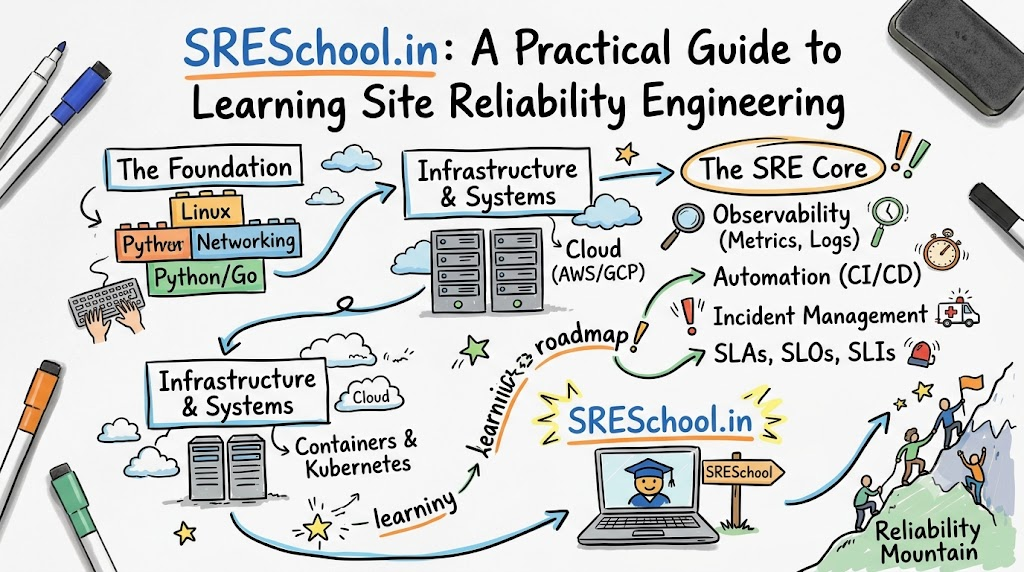
How to Build a Simple SRE Learning Path
A practical learning path can start with foundations and gradually move toward production reliability.
Step 1: Learn core infrastructure concepts
Understand Linux, networking, cloud basics, applications, and databases.
Step 2: Learn DevOps fundamentals
Study version control, CI/CD, deployments, containers, and infrastructure.
Step 3: Learn SRE concepts
Focus on SLOs, SLIs, SLAs, error budgets, reliability, and toil.
Step 4: Practice observability
Work with metrics, logs, traces, dashboards, and alerts.
Step 5: Study incident response
Learn how teams detect, manage, communicate, and review incidents.
Step 6: Practice automation
Automate repetitive tasks carefully and measure the results.
Step 7: Build practical projects
Create small production-style environments and practice troubleshooting.
A structured SRE Course or SRE Tutorial series can help organize this journey.
Understanding SRE Training in India
SRE Training in India can be useful for professionals who want to connect software, cloud, DevOps, infrastructure, and reliability engineering.
Learners can focus on skills such as:
- Cloud platforms
- Software engineering
- Infrastructure
- Automation
- Monitoring
- Observability
- Incident response
- Production operations
- Troubleshooting
- Reliability engineering
Professionals should compare courses based on curriculum, practical work, trainer experience, learning format, and their own career goals.
Training does not automatically lead to employment. Building useful technical skills and gaining practical experience remain important parts of professional development.
How SRESchool.in Supports SRE Learning
SRESchool.in is focused on Site Reliability Engineering learning and related areas such as cloud reliability, automation, monitoring, observability, incident management, and production systems.
For someone starting with SRE, the platform can provide a structured place to explore important concepts. Learners can also use SRE-focused resources to understand how areas such as Kubernetes, Terraform, monitoring, DevOps, and automation connect with reliability engineering.
The platform can be considered alongside other learning methods, including documentation, practical labs, personal projects, and real production experience.
The most useful approach is to combine structured learning with regular hands-on practice.
Why Learning SRE Is Becoming More Useful
As systems become more connected, reliability becomes an engineering concern rather than only an operations responsibility.
Developers may need to understand service health. Cloud engineers may need to think about availability and scaling. Platform teams may need strong observability. Operations teams may automate more work. SRE brings these concerns together around measurable reliability goals.
Learning SRE can therefore help professionals understand how software and infrastructure behave in production.
The most valuable learning usually comes from applying concepts. Reading about incidents, building monitoring, testing failure scenarios, and automating repetitive tasks can turn theoretical knowledge into practical engineering ability.
Frequently Asked Questions About SRESchool.in
1. What is SRESchool.in?
SRESchool.in is a learning platform focused on Site Reliability Engineering and related areas such as cloud reliability, monitoring, observability, automation, incident management, and production systems.
2. What can I learn through SRE Training?
SRE Training can cover SLOs, SLIs, error budgets, monitoring, observability, incident response, automation, cloud reliability, capacity planning, troubleshooting, and production operations.
3. Is SRE Certification necessary to become an SRE Engineer?
No. Certification is not the only path to becoming an SRE Engineer. Practical experience, software knowledge, infrastructure skills, troubleshooting ability, automation, and production experience also matter.
4. What should I look for in an SRE Course?
Look for a course with clear concepts, practical exercises, SRE fundamentals, observability, incident management, automation, SLOs, troubleshooting, and production-focused examples.
5. What is the difference between SRE Training and SRE Certification?
Training focuses on learning skills and concepts, while certification generally assesses knowledge against requirements defined by a certification provider. They can complement each other but serve different purposes.
6. Can an SRE Tutorial help beginners?
Yes. A well-structured SRE Tutorial can explain difficult topics step by step. Beginners can start with reliability concepts and gradually move into monitoring, cloud, automation, incidents, and production systems.
7. Which SRE Tools should beginners learn?
Beginners should first understand tool categories such as monitoring, logging, tracing, alerting, incident management, infrastructure management, and deployment. Specific tools can be selected based on the technology environment.
8. What are important SRE Best Practices?
Important practices include setting reliability goals, using meaningful SLOs and SLIs, improving observability, reducing repetitive work, preparing for incidents, learning from failures, automating suitable tasks, and planning capacity.
9. What does an SRE Engineer do?
An SRE Engineer may work on software, infrastructure, cloud systems, monitoring, automation, troubleshooting, incident response, deployments, performance, and reliability. Responsibilities vary by organization.
10. Is SRE Training in India useful for IT professionals?
It can help professionals build knowledge across cloud, DevOps, software engineering, infrastructure, monitoring, automation, and production reliability. The value depends on the learner’s goals, course quality, practical experience, and existing technical skills.
Final Thoughts
Site Reliability Engineering brings software engineering and operational thinking together around one important goal: building systems that people can depend on.Learning SRE takes more than memorizing terms. Professionals need to understand reliability goals, observe system behavior, respond to incidents, automate suitable work, and learn from failures.An SRE Course, SRE Tutorial, or structured Site Reliability Engineering Training can provide direction, while practical projects and production experience help turn that knowledge into useful skills.SRESchool.in can serve as one learning resource for people exploring SRE Training, SRE Certification, SRE Tools, SRE Best Practices, and the broader skills required for SRE work. The right learning path ultimately depends on the learner’s current experience, technology background, and professional goals.
Leave a Reply