Military Strategy, Defense Studies, Operations, Technology, and Modern Defense Systems

September 16, 2026 · 16 reads
Introduction
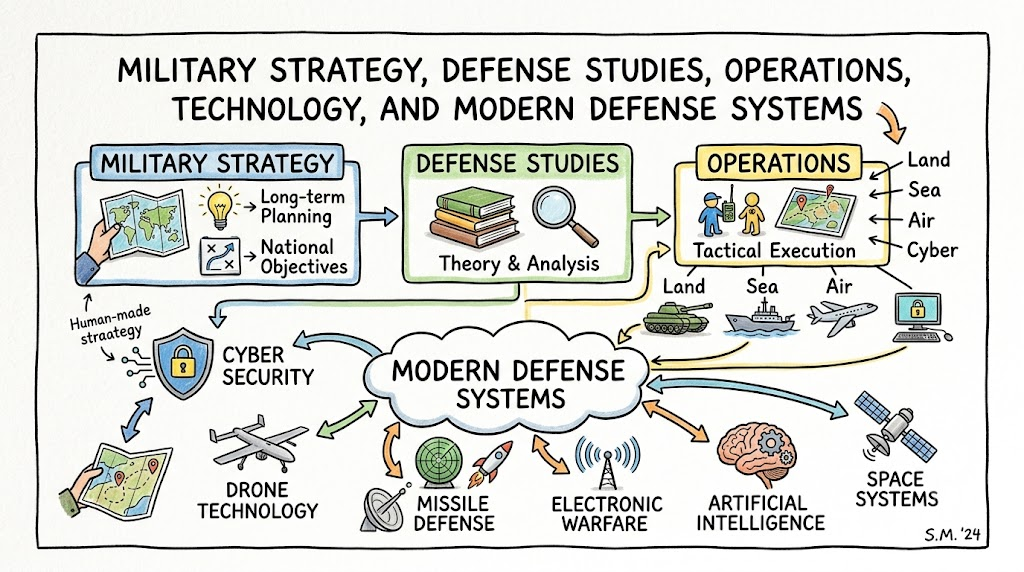
Defense is a broad field that combines strategy, organizational planning, technology, logistics, leadership, information, and historical experience. Looking at only one of these areas can make it difficult to understand how modern military organizations function as interconnected systems.
WarOpsX provides an educational framework for exploring these subjects together. Its areas of interest include Military Strategy, Defense Studies, Military Operations, Military Logistics, Command and Control Systems, Defense Technology, Military History, Military Organizational Structure, Multidomain Operations, and Intelligence Surveillance and Reconnaissance.
For students and researchers, this approach creates an opportunity to study defense concepts from a systems perspective. It also helps professionals and general readers understand important terminology without turning educational material into tactical combat guidance.
Understanding Military Strategy and Strategic Decision-Making
Military Strategy focuses on the relationship between objectives, resources, organizations, leadership, and strategic choices. Rather than concentrating on individual actions, strategic study examines how broader objectives shape decisions and how organizations manage constraints.
Strategic decision-making can involve questions such as:
- What objectives does an organization need to pursue?
- What resources and capabilities are available?
- What limitations could affect strategic choices?
- How should leaders balance competing priorities?
- How can organizations maintain readiness over time?
Furthermore, strategy does not exist separately from other defense functions. Logistics, intelligence, technology, organizational structure, and leadership can all influence strategic choices.
Exploring Defense Studies and Modern Security Concepts
Defense Studies brings several academic and professional disciplines together to examine military institutions and security environments. Depending on the course or research area, it may involve history, political science, international relations, technology, economics, organizational studies, and strategic thought.
This broad perspective helps learners move beyond simple descriptions of military forces. Instead, they can investigate why defense institutions develop particular structures, how strategic ideas change, and how political or technological conditions influence organizational decisions.
Because every country and institution operates within different circumstances, readers should treat general frameworks as starting points rather than universal rules. Organizational structures, doctrines, terminology, and priorities can vary considerably.
Understanding Military Operations Beyond Tactical Combat
Military Operations involve coordinated organizational activity designed to support broader strategic objectives. In an educational context, the subject can include planning, leadership, coordination, readiness, logistics, communication, information management, and resource allocation.
This distinction matters because military operations do not consist solely of combat activity. Large organizations require extensive support systems before, during, and after operational activity.
For learners, studying operations at a conceptual level can therefore provide insight into how different functions interact. It also allows readers to examine decision-making and coordination without entering into actionable battlefield procedures.
How Military Logistics Supports Organizational Readiness
Military Logistics provides the support structure that allows large organizations to maintain resources and readiness. It can include transportation, supply management, maintenance, infrastructure, inventory planning, and resource allocation.
Logistics often receives less attention than strategy or technology, yet it plays an important role in organizational sustainability. Equipment requires maintenance, personnel require support, and resources must move through appropriate supply systems.
Key areas for study include:
- Supply and inventory management
- Transportation systems
- Maintenance planning
- Infrastructure support
- Resource allocation
- Sustainment and readiness
- Administrative coordination
Consequently, logistics offers an important lesson in systems thinking: strategic plans depend on practical support mechanisms.
Understanding Command and Control Systems
Command and Control Systems help organizations coordinate people, information, responsibilities, and decisions. At a high level, these systems connect leadership with communication and information-management processes.
A command structure determines who holds particular responsibilities, while control mechanisms help organizations coordinate activities and monitor relevant information. Technology can support these processes, but technology alone does not create effective command and control.
Organizational culture, training, leadership, communication procedures, information quality, and institutional design also matter. Therefore, studying Command and Control Systems requires both technical and organizational perspectives.
Exploring the Role of Defense Technology
Defense Technology covers a wide range of technologies that can influence military organizations and security institutions. Examples include artificial intelligence, autonomous systems, sensors, communications technologies, simulation environments, information systems, and cyber capabilities.
However, technological advancement does not automatically translate into organizational effectiveness. Institutions must consider training, integration, maintenance, governance, infrastructure, interoperability, and responsible use.
For this reason, technology should be studied as part of a larger system. A useful educational question is not simply what a technology can do, but how organizations adapt when they introduce that technology into existing structures and processes.
Learning From Military History and Strategic Evolution
Military History provides more than a record of conflicts. It can help researchers understand how military institutions changed in response to political conditions, technological developments, economic resources, organizational challenges, and strategic thinking.
Historical research can examine subjects such as:
- Development of military institutions
- Evolution of command structures
- Changes in logistics
- Technological adaptation
- Strategic decision-making
- Organizational lessons
- Relationships between political objectives and military institutions
At the same time, historical interpretation requires care. Scholars may disagree about the causes or significance of particular events. Readers should therefore separate documented historical evidence from later interpretation.
Understanding Military Organizational Structure
Military Organizational Structure explains how institutions arrange authority, responsibilities, units, personnel, and support functions. Structures can differ substantially between countries and organizations.
Learners may encounter concepts involving:
- Service branches
- Units and formations
- Headquarters
- Staff organizations
- Joint structures
- Command relationships
- Specialized support functions
Understanding these relationships helps explain how large institutions divide responsibilities while maintaining coordination.
Moreover, organizational structure often reflects strategic requirements, administrative traditions, available resources, and institutional priorities. Consequently, readers should avoid treating one organizational model as the standard for every military institution.
Exploring Multidomain Operations Across Modern Defense Environments
Multidomain Operations examines relationships among multiple environments, including land, maritime, air, space, cyber, and information. The concept reflects the growing importance of coordination across traditionally distinct areas.
The educational value of multidomain thinking lies in understanding interdependence. Decisions in one environment can affect information requirements, communications, logistics, organizational coordination, or strategic planning elsewhere.
Therefore, multidomain operations should not simply mean adding more technologies or capabilities. It also involves organizational learning, information sharing, leadership coordination, and the ability to understand complex systems.
Understanding Intelligence Surveillance and Reconnaissance
Intelligence Surveillance and Reconnaissance supports decision-making by helping organizations collect, process, analyze, and understand information. These functions contribute to situational awareness and can help decision-makers manage uncertainty.
At a high level, learners can examine the relationship between information collection and analysis. They can also explore important limitations, including incomplete information, uncertain sources, data quality, analytical assumptions, and information overload.
Responsible study should emphasize the analytical and organizational role of these functions rather than providing detailed surveillance or targeting procedures.
How Strategy, Technology, Leadership, and Logistics Work Together
Defense organizations operate through interconnected functions. Strategy establishes direction, leadership coordinates people, technology provides capabilities, logistics supports resources, and intelligence contributes information for decision-making.
| Defense area | Primary educational focus |
|---|---|
| Military Strategy | Objectives and strategic choices |
| Defense Studies | Security, institutions, policy, and research |
| Military Operations | Planning, coordination, and readiness |
| Military Logistics | Sustainment and resource management |
| Command and Control | Leadership and organizational coordination |
| Defense Technology | Technology and institutional adaptation |
| Military History | Historical development and strategic lessons |
| ISR | Information and situational awareness |
Looking across these areas helps learners understand why defense organizations require more than individual capabilities.
Comparing Traditional and Modern Defense Systems
Defense systems have changed as communication methods, information technologies, organizational models, and strategic environments have evolved. Nevertheless, many fundamental requirements remain relevant, including leadership, planning, logistics, training, information, and organizational coordination.
| Traditional approach | Modern approach |
|---|---|
| Greater emphasis on physical information flows | Greater reliance on digital information environments |
| More distinct functional boundaries | Greater emphasis on cross-domain integration |
| Platform-focused thinking | Increased attention to connected systems |
| Established communication structures | More complex networked environments |
| Domain-specific perspectives | Greater interest in multidomain relationships |
These differences represent broad educational themes rather than a universal description of every defense organization.
How Students and Researchers Can Study Defense Concepts
A structured learning approach can make a complex subject easier to manage. Instead of beginning with highly specialized topics, learners can establish foundational knowledge and gradually connect different areas.
A practical study method could include:
- Start with basic defense and security terminology.
- Learn fundamental Military Strategy concepts.
- Study Military Organizational Structure.
- Examine Military Logistics and readiness.
- Understand Command and Control Systems.
- Explore Military History and institutional development.
- Study Defense Technology at a conceptual level.
- Examine Multidomain Operations.
- Learn how Intelligence Surveillance and Reconnaissance supports decision-making.
- Compare different perspectives and evaluate source quality.
This approach encourages analysis instead of simple memorization.
Building a Better Understanding of Modern Military Systems
Modern defense systems contain technical, human, organizational, and strategic dimensions. As a result, learners should examine how these dimensions influence one another.
For example, a new technology may require changes in training, organizational responsibilities, infrastructure, maintenance, information management, and governance. Similarly, a logistics challenge may influence readiness and strategic planning.
This systems-based perspective gives students a stronger foundation for academic research and professional discussion. It also encourages them to question assumptions and recognize where publicly available information remains limited.
How WarOpsX Supports Defense and Strategy Learning
WarOpsX focuses on organizing defense-related knowledge across multiple connected subjects. Readers can explore strategic concepts alongside technology, military history, organizational systems, logistics, and information-related topics.
This structure can help learners create connections between subjects that often appear separately in traditional resources. For example, someone studying Military Strategy can also explore how logistics, organizational design, technology, and intelligence affect strategic decision-making.
The platform’s educational orientation makes it suitable as a starting point for readers who want accessible explanations before moving toward deeper academic or professional research.
Why Structured Defense Information Is Becoming More Important
Defense knowledge can become difficult to navigate because terminology spans multiple disciplines. Strategy uses one set of concepts, technology introduces another, while organizational studies and military history add further perspectives.
Structured information can make these relationships easier to understand. Instead of treating every subject as an isolated topic, learners can examine how strategic objectives connect with people, resources, information, institutions, and technology.
Furthermore, responsible defense education should encourage source evaluation and intellectual caution. Readers should recognize the difference between established facts, analytical interpretations, institutional perspectives, and information that remains unavailable publicly.
Frequently Asked Questions About WarOpsX
1. What is WarOpsX?
WarOpsX is an educational platform focused on Military Strategy, Defense Studies, Military Operations, Military Logistics, Defense Technology, Military History, organizational systems, Multidomain Operations, and Intelligence Surveillance and Reconnaissance.
2. Who can use WarOpsX for learning?
Students, researchers, defense enthusiasts, policy learners, professionals, and other readers interested in defense concepts can use structured educational resources to develop foundational knowledge.
3. What does Military Strategy study?
Military Strategy examines how broader objectives connect with resources, leadership, organizational capabilities, information, logistics, and strategic decision-making.
4. How does Defense Studies differ from studying military history?
Military History focuses primarily on historical events, institutions, developments, and interpretations. Defense Studies has a broader scope and can include strategy, policy, technology, organizational studies, security, and international affairs.
5. Why does Military Logistics matter to defense organizations?
Military Logistics supports sustainment and readiness through areas such as transportation, supply management, maintenance, infrastructure, and resource planning.
6. What are Command and Control Systems?
Command and Control Systems support organizational leadership, communication, coordination, information management, and decision-making. Their design varies by organization and context.
7. What subjects are included in Defense Technology?
Defense Technology can include artificial intelligence, autonomous systems, sensors, communications, simulation, information technologies, and cyber capabilities. Specific applications vary by organization and context.
8. What can Military History teach researchers?
Military History can provide insight into organizational development, strategic decision-making, technological change, logistics, leadership, and institutional adaptation.
9. What does Multidomain Operations mean?
Multidomain Operations considers interactions across land, maritime, air, space, cyber, and information environments. It emphasizes coordination across multiple domains.
10. How does Intelligence Surveillance and Reconnaissance support decision-making?
Intelligence Surveillance and Reconnaissance contributes information, monitoring, analysis, and situational awareness that can help decision-makers understand conditions and uncertainty.
Final Thoughts
Defense is best understood as a connected system rather than a collection of unrelated subjects. Military Strategy, Defense Studies, Military Operations, Military Logistics, Command and Control Systems, Defense Technology, Military History, organizational structure, Multidomain Operations, and Intelligence Surveillance and Reconnaissance each provide a different perspective on that system.
WarOpsX offers a structured educational starting point for exploring these relationships. More importantly, effective defense learning requires careful research, historical context, source evaluation, and an appreciation of organizational complexity.
By studying how strategy, leadership, technology, logistics, information, and institutions interact, learners can develop a clearer and more balanced understanding of defense systems without relying on tactical or operational instruction.
Leave a Reply