MAHTO.IN: Farming Guidance, Government Support, and New Rural Opportunities

October 9, 2026 · 4 reads
Introduction
Farming decisions affect more than crop production. They influence household spending, water use, soil health, and the income a family earns from its land. Farmers must balance these needs while dealing with changing weather, rising input costs, and uncertain market prices.
Rural families also look for reliable information about government assistance, livestock care, and small businesses. Without clear guidance, they may spend money on unsuitable products or misunderstand important requirements.
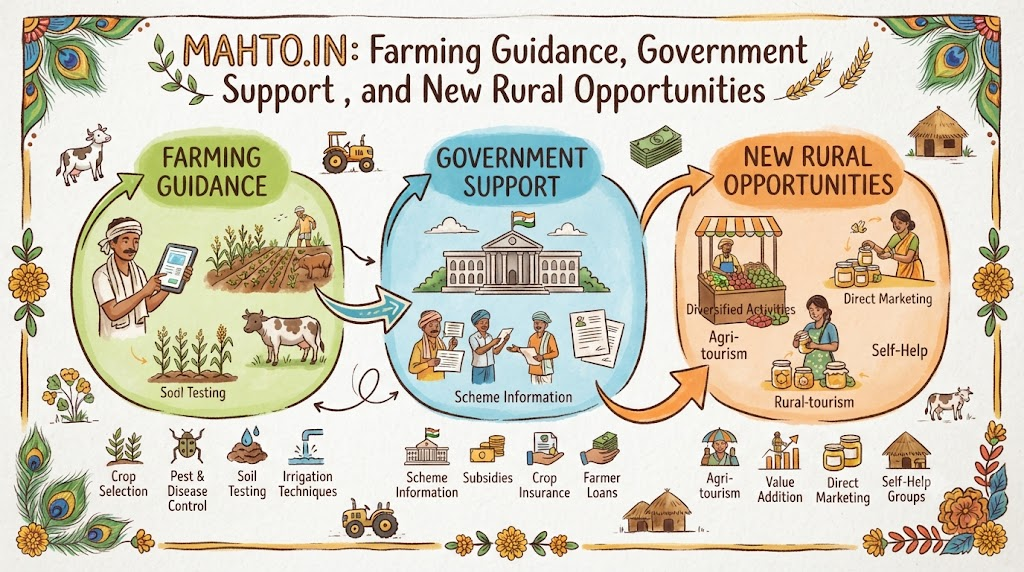
MAHTO.IN focuses on practical rural knowledge for farmers, livestock owners, and village entrepreneurs. This guide explores ways to improve farm planning, manage resources, understand government schemes, and develop rural business ideas. It also explains the precautions readers should take before making important financial or agricultural decisions.
1. Understand the Real Needs of Your Farm
A good farming decision begins with understanding the land and available resources. Farmers should review soil conditions, water access, crop history, labor availability, and their budget before planning the next season.
For example, a farmer with limited irrigation should consider crops that suit the local water supply. A farmer with high transport costs should study nearby selling options before choosing a crop with special storage needs.
Prepare a Farm Information Sheet
Farmers can maintain a simple record containing:
- Total cultivated land and field boundaries.
- Main crops grown during previous seasons.
- Soil test results, if available.
- Available irrigation sources.
- Farm equipment and labor needs.
- Main production expenses.
- Nearby markets and possible buyers.
This information can help farmers identify problems and plan future activities. They should update the record whenever important conditions change.
2. Choose Crops With Practical Goals
Crop selection should balance growing conditions, production costs, water needs, and market demand. Farmers should not choose a crop only because its selling price appears high.
Study the Local Growing Conditions
Soil type, temperature, rainfall, and irrigation availability affect crop development. Farmers should learn which crops and varieties suit their region.
A soil test can provide useful information about nutrient levels and other soil properties. Local agricultural officers and Krishi Vigyan Kendras can help farmers understand the results.
Farmers should also consider the length of the growing season. A crop that needs more time or water than the farm can provide may create unnecessary risks.
Select Quality Seeds
Farmers should buy seeds from reliable suppliers. They should check the variety, package details, and suitability for local conditions.
Before sowing, they should confirm the recommended seed rate, spacing, and planting time. These requirements vary by crop and variety.
Farmers should avoid choosing seed varieties based only on advertisements or unsupported claims. Local agricultural recommendations provide a better starting point.
Consider Crop Rotation
Crop rotation involves growing different crops in sequence on the same field. Suitable rotations can help manage some pests and diseases and support soil management.
The best rotation depends on soil conditions, water availability, crop choices, and local demand. Farmers should seek regional guidance before changing their cropping system.
3. Protect Soil Health Through Better Practices
Healthy soil supports plant roots, stores moisture, and supplies nutrients. Poor soil management can increase costs and affect future crop growth.
Apply Fertilizers Correctly
Plants need nutrients in suitable amounts. Nitrogen supports leaf and stem growth, phosphorus supports root development and other plant functions, and potassium supports several important growth processes.
Farmers should avoid applying extra fertilizer without understanding crop needs. Excessive use can waste money and may affect soil and water quality.
A soil test can help farmers plan nutrient use. They should follow crop-specific recommendations and apply fertilizers at suitable times.
Use Organic Materials Wisely
Well-decomposed compost and farmyard manure can add organic matter and improve soil structure. Farmers should use clean, properly prepared materials.
Organic inputs differ in nutrient content and quality. Farmers should consider these differences when planning their use.
Reduce Soil Erosion
Rain and wind can remove fertile topsoil. Farmers can reduce erosion through suitable ground cover, proper drainage, and other conservation practices.
Sloping fields may need additional protection. Local agricultural experts can recommend methods that suit the land.
4. Plan Water Use for the Entire Season
Water availability affects crop growth and farm expenses. Farmers should consider rainfall, soil moisture, crop stage, and weather conditions before irrigating.
Too little water can stress plants. Excessive irrigation may cause waterlogging, damage roots, and waste resources.
Practical Ways to Improve Water Management
Farmers can:
- Repair leaking pipes and damaged irrigation channels.
- Keep field drainage clear.
- Check soil moisture before watering.
- Use suitable mulch to reduce moisture loss.
- Collect rainwater where safe and permitted.
- Explore drip or sprinkler irrigation when practical.
- Avoid unnecessary irrigation before expected rainfall.
Drip irrigation delivers water close to plant roots. Sprinkler systems distribute water over the crop area. Both require suitable equipment and regular maintenance.
Before investing, farmers should compare installation costs, maintenance needs, water availability, and crop requirements. A system that suits one farm may not suit another.
5. Check Government Schemes Before Applying
Government schemes may help eligible farmers access financial assistance, agricultural credit, crop insurance, irrigation support, equipment programs, or training.
However, each scheme has its own conditions. Farmers should confirm current details through official government channels rather than relying on unverified claims.
Understand Eligibility Requirements
Applicants should check the purpose of the scheme and confirm whether they qualify. Depending on the program, they may need identity information, bank details, land records, or other documents.
Some schemes may require eKYC or additional verification. Farmers should check the latest instructions because requirements can vary.
Avoid Common Application Problems
Before submitting an application, farmers should:
- Read the current official instructions.
- Check their personal and bank details.
- Prepare the required documents.
- Complete all necessary verification steps.
- Keep an application receipt or reference number when available.
- Use the official process to check application status.
Applicants should never share bank PINs, passwords, or one-time passwords with unknown callers. They should also avoid paying people who promise guaranteed approval.
MAHTO.IN covers rural information and farmer welfare topics, but official government departments remain the proper source for scheme rules and decisions.
6. Measure Farm Expenses and Income
Farmers may spend money for several months before selling a harvest. Common expenses include seeds, fertilizers, labor, irrigation, crop protection, harvesting, and transport.
Written records help farmers understand where their money goes. They can also show which costs need better planning.
| Record category | Information to note |
|---|---|
| Seeds | Variety, quantity, and price |
| Fertilizers | Product, amount, and cost |
| Labor | Work completed and wages |
| Irrigation | Water, electricity, fuel, and repairs |
| Crop protection | Products and application expenses |
| Harvesting | Labor and equipment costs |
| Transport | Loading and delivery expenses |
| Sales | Quantity sold, price, and payment received |
Farmers can use a notebook or spreadsheet to track these details. They should review the records after harvest and compare total expenses with sales income.
Make Careful Borrowing Decisions
Agricultural loans can help cover necessary costs. However, borrowers must understand the repayment terms before accepting a loan.
Farmers should compare interest rates, fees, repayment dates, and other conditions. They should also consider the risk of lower yields or falling prices.
Borrowing should match a clear need and a realistic repayment plan. No crop guarantees a fixed income.
7. Identify Crop Problems Before Treating Them
Pests and diseases can damage plants and reduce crop quality. Regular field inspections help farmers notice unusual changes early.
Farmers should check leaves, stems, and other plant parts for spots, holes, wilting, or unusual growth. They should also observe how widely the damage has spread.
Use Integrated Pest Management
Integrated Pest Management combines prevention, monitoring, and suitable control methods. It helps farmers manage pests without relying only on chemical pesticides.
Useful practices include:
- Inspecting crops regularly.
- Maintaining field hygiene.
- Rotating crops where appropriate.
- Using resistant varieties when available.
- Protecting beneficial insects.
- Removing affected plant material when suitable.
- Applying approved pesticides only when needed.
Farmers should identify the problem before selecting a treatment. The wrong product can waste money or harm crops and helpful insects.
Always follow the pesticide label for dosage, protective equipment, application instructions, and waiting periods before harvest. Seek qualified agricultural advice when the cause of damage remains unclear.
8. Manage Livestock With Proper Care
Livestock can provide milk, eggs, meat, and other products for rural households. However, raising animals requires daily attention and careful financial planning.
Owners should provide clean water, suitable housing, balanced feed, and access to veterinary services.
Dairy Farming
Dairy farmers should provide feed according to the animal’s age, condition, and milk production. They should also maintain clean housing and hygienic milking practices.
Clean equipment and safe milk storage help protect milk quality. Farmers should record milk production, feed expenses, veterinary costs, and sales.
Before starting a dairy business, they should calculate the costs of animals, feed, housing, equipment, and veterinary care. They should also identify reliable buyers.
Goat Farming
Goat farming may suit some rural areas, depending on local conditions and market demand. Farmers should select healthy animals and breeds suitable for their region.
They should provide dry shelter, appropriate feed, clean water, and suitable disease prevention. Regular veterinary guidance can help protect animal health.
Poultry Farming
Poultry farming can supply eggs or meat to nearby markets. Owners must manage housing, feed, temperature, hygiene, and disease prevention.
Before starting, they should estimate the cost of chicks, feed, equipment, and regular care. They should also study local demand and identify possible buyers.
Livestock businesses do not guarantee fixed profits. Feed prices, disease risks, and market conditions can affect income. Farmers should consult a qualified veterinarian about animal illness, vaccination, and treatment.
9. Build a Rural Business Around Local Demand
Village businesses can provide useful services and create income opportunities. A suitable business usually meets a need that customers already have.
People should consider their skills, available money, space, competition, and customer demand before investing.
Rural Business Options
| Business idea | Main requirement | Important consideration |
|---|---|---|
| Farm supply shop | Reliable suppliers and stock | Local demand |
| Vegetable selling | Fresh produce and transport | Spoilage and price changes |
| Food processing | Equipment and hygiene | Applicable approvals |
| Farm equipment rental | Machinery and maintenance | Seasonal demand |
| Tailoring service | Skills and equipment | Customer needs |
| Dairy product sales | Safe handling and storage | Reliable buyers |
| Digital service center | Equipment and digital skills | Authorized services |
| Poultry farming | Housing, feed, and animal care | Disease and market risks |
These ideas are possibilities, not guarantees of income. Their suitability depends on local demand and business management.
Test Demand Before Spending More
A new entrepreneur should speak with potential customers and study existing businesses. They should estimate startup costs, monthly expenses, selling prices, and possible losses.
For example, a person who wants to open a farm supply shop should first learn which products local farmers need. They should also compare suppliers and calculate how much stock they can afford.
Starting small can help test demand. Clear records of sales, expenses, debts, and customer payments help business owners review their progress.
10. Compare Market Prices and Selling Costs
Mandi prices can change according to supply, demand, crop quality, season, and location. Farmers should check current rates before deciding where to sell.
A higher price in another market may not provide better earnings after transport and handling costs. Farmers should calculate the amount they expect to receive after expenses.
Before selling, they should consider:
- Current prices for the crop and its quality.
- Transport and loading charges.
- Applicable market fees.
- Storage expenses and spoilage risks.
- Buyer reliability and payment terms.
- The quantity available for sale.
Farmers can check reliable market information sources and contact local mandi offices. They should confirm prices because rates can change frequently.
Keeping sales records helps farmers compare buyers and plan future harvests.
11. Prepare for Weather-Related Problems
Weather affects sowing, irrigation, pest control, harvesting, and storage. Heavy rain, heat, and irregular rainfall can create different risks.
Farmers should follow reliable local forecasts and agricultural advisories. They should adjust their activities when conditions require a change.
Practical steps include clearing drainage channels, storing seeds in dry places, protecting equipment, and planning irrigation carefully. Farmers should avoid spraying crops when weather conditions make the application unsafe or ineffective.
Forecasts cannot prevent every loss. However, timely preparation can reduce avoidable damage and help farmers use resources more carefully.
12. Develop Skills for Rural Employment
Young people in villages can explore work in agriculture, livestock care, food processing, equipment repair, digital services, and local trade.
They should first understand the needs of local employers and customers. A farming area may need machinery repair services, while another village may need tailoring or digital assistance.
Before joining a training program, learners should check the provider’s credibility, course content, fees, and practical training opportunities. They should be cautious about programs that promise guaranteed jobs or income.
Skills such as basic accounting, communication, customer service, and recordkeeping can support many types of work. Practical experience can also help young people understand customer needs and business challenges.
Common Mistakes to Avoid
Rural families can reduce avoidable losses by recognizing common mistakes.
1. Selecting crops without checking local conditions: Farmers should consider soil, climate, water supply, and crop suitability before sowing.
2. Applying too much fertilizer: Soil tests and crop-specific recommendations can help farmers use nutrients appropriately.
3. Treating crops without identifying the problem: Correct identification helps farmers choose suitable pest or disease control methods.
4. Trusting unofficial scheme promises: Applicants should confirm current rules through official channels and protect personal information.
5. Borrowing without a repayment plan: Farmers should review loan terms and consider possible changes in income.
6. Ignoring livestock hygiene: Clean housing, proper feed, and veterinary care help protect animal health.
7. Investing in a business without studying demand: Entrepreneurs should check customers, competition, costs, and selling prices.
8. Failing to maintain financial records: Written records help families understand costs and prepare realistic budgets.
Important Considerations
Agricultural methods and rural business decisions depend on local conditions. A practice that suits one crop, district, or livestock breed may not suit another.
Government rules, market prices, and weather conditions can change. Readers should verify current information through reliable sources before making decisions that affect their money or livelihood.
Farmers should seek qualified agricultural advice for serious crop problems. Livestock owners should consult veterinarians about animal illness, vaccination, and treatment.
People planning a business should estimate startup costs, recurring expenses, and possible losses. They should also check relevant registrations, licenses, and safety requirements before starting operations.
How MAHTO.IN Supports Rural Learning
MAHTO.IN focuses on educational information about farming, farmer welfare, livestock, rural businesses, and village development. Its content aims to make practical rural topics easier to understand.
Farmers can use educational material to prepare questions for agricultural officers. Livestock owners can learn about basic care practices, while aspiring entrepreneurs can explore customer needs and business planning.
Readers should use this information as a starting point and confirm important details through official departments, qualified professionals, and reliable local sources. Combining knowledge with local experience can support better decisions.
Frequently Asked Questions (FAQs)
1. What is MAHTO.IN?
MAHTO.IN is a rural information platform focused on agriculture, farmer welfare, livestock management, and village business opportunities. It aims to make practical information easier to understand.
2. How can farmers prepare for a new growing season?
Farmers should review soil conditions, crop needs, seeds, water availability, labor, costs, and market options. A seasonal plan helps them organize activities and prepare for possible risks.
3. Why should farmers test their soil?
Soil testing helps farmers understand nutrient levels and other important soil conditions. They can use the results to plan fertilizer application and avoid unnecessary expenses.
4. How can farmers reduce water waste?
Farmers can repair leaks, check soil moisture, maintain drainage, and consider suitable water-saving methods. The right approach depends on crop needs, field conditions, and available funds.
5. How can farmers verify government scheme information?
Farmers should consult official government portals, authorized service centers, or relevant departments. They should confirm current eligibility, required documents, and application procedures.
6. How can farmers manage crop pests safely?
Farmers should inspect crops, identify pests correctly, and use suitable prevention methods. They should follow approved pesticide labels and seek qualified agricultural advice when needed.
7. What financial records should farmers maintain?
Farmers should record input purchases, labor, irrigation, crop protection, harvesting, transport, and sales. These records help them understand production costs and prepare realistic budgets.
8. What should people consider before starting livestock farming?
They should estimate feed, housing, equipment, veterinary care, labor, and transport costs. They should also study local demand and arrange suitable animal care.
9. Which businesses can rural entrepreneurs explore?
Possible options include farm supply shops, vegetable selling, tailoring, food processing, machinery rental, and digital services. The right choice depends on local demand, skills, investment, and applicable rules.
10. How can farmers compare selling options?
Farmers should compare current prices, crop quality, transport costs, storage needs, and buyer reliability. They should calculate the final amount they expect to receive after expenses.
11. How can young people prepare for rural entrepreneurship?
Young people can learn useful skills, study local demand, speak with potential customers, and prepare a budget. Testing an idea on a small scale can help reduce financial risk.
12. Can MAHTO.IN guarantee farming success or business profits?
No platform can guarantee crop yields or business profits. Results depend on weather, costs, prices, skills, and management. Readers should verify important information and seek expert advice when needed.
Conclusion
Better rural livelihoods depend on practical knowledge, careful planning, and responsible decisions. Farmers can improve their work by selecting suitable crops, protecting soil, managing water, and tracking expenses. Livestock owners can focus on proper feeding, hygiene, and animal health. Rural entrepreneurs can study local demand before investing.Government schemes and market information may help eligible families make informed choices. However, changing rules, prices, and local conditions require regular verification.MAHTO.IN aims to make useful rural information easier to understand. Readers can combine this knowledge with local experience and professional guidance to make decisions that suit their farms, families, and business goals.
Leave a Reply