IVF Treatment Guide: Costs, Success Rates, Clinics, and Treatment Options

October 6, 2026 · 22 reads
Introduction
Fertility treatment can feel confusing when you first start researching it. IVF is a well-known option, but it is not the only fertility treatment. People may also learn about IUI, ICSI, egg freezing, embryo freezing, and donor treatment.
Cost is another important part of fertility research. IVF treatment cost can vary between clinics and countries. The quoted price may also leave out medicines, tests, storage, or other services. So, looking at the full cost can give a clearer picture.
IVF success rates also need careful review. Clinics may use different measures and patient groups. This guide explains IVF treatment, IVF costs, success rates, IVF clinics, clinic comparison, IVF abroad, egg freezing, ICSI treatment, and other fertility treatment options. It also explains how to prepare for a useful fertility consultation.
What Is IVF Treatment?
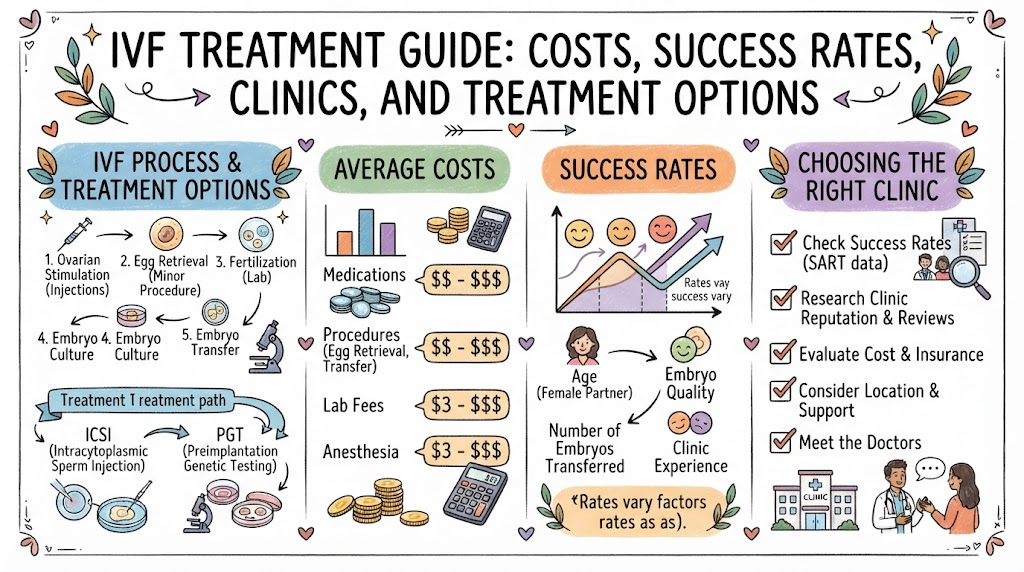
IVF means in vitro fertilisation. It is a fertility treatment where fertilisation takes place in a laboratory. The process usually involves several stages, but the exact plan can differ between patients.
Treatment often starts with a fertility assessment. A specialist may review medical history and recommend suitable tests. Ovarian stimulation may then help the ovaries develop several follicles.
The clinic monitors follicle development during treatment. When the eggs are ready, the clinic collects them during an egg retrieval procedure.
The laboratory then uses sperm for fertilisation. Standard IVF and ICSI treatment use different methods for fertilisation.
Embryos may develop in the laboratory after fertilisation. A clinic may transfer an embryo into the uterus. Some embryos may instead be frozen for possible future use.
A pregnancy test can then check whether pregnancy has occurred. The timing depends on the treatment plan.
IVF does not follow one fixed process for every patient. Age, fertility history, test results, egg and sperm factors, and previous treatment can all affect the plan.
Main Steps in IVF Treatment
Understanding the main stages can make fertility discussions easier. These stages provide general education and do not replace a personal medical plan.
Fertility Assessment
The process often starts with a fertility assessment. A specialist may review medical history, previous treatment, and fertility concerns.
The clinic may also recommend blood tests, ultrasound, semen analysis, or other assessments. The exact tests depend on clinical needs.
Ovarian Stimulation
Some IVF cycles use medicines to stimulate the ovaries. This process may help several follicles develop.
The clinic can monitor the response with scans and blood tests. Treatment decisions depend on the patient’s response.
Egg Retrieval
A medical procedure collects mature eggs from the ovaries. The clinic plans the procedure based on follicle development and other findings.
Sperm Collection
The laboratory needs sperm for fertilisation. Sperm may come from a partner or donor when appropriate and legally available.
Fertilisation
The laboratory combines eggs and sperm. Standard IVF allows sperm to fertilise an egg in the laboratory.
ICSI uses a different approach. An embryologist injects one sperm directly into an egg.
Embryo Development
Fertilised eggs may develop into embryos. The embryology team monitors their development in the laboratory.
Embryo Transfer
A clinic may transfer an embryo into the uterus. Other embryos may remain frozen for possible future treatment.
Pregnancy Testing
The clinic provides instructions about pregnancy testing. The timing can differ based on the treatment plan.
Not every patient needs the same procedures. A fertility specialist can explain the steps that apply to an individual situation.
Understanding IVF Treatment Cost
IVF treatment cost can vary for many reasons. A clinic may advertise a base price, but that price may not cover every service.
Medicines may have separate charges. Fertility testing may also cost extra. Embryo freezing, storage, genetic testing, and donor services can add further costs.
The number of treatment cycles can also affect total spending. Some people may need more than one cycle.
People who choose IVF abroad should also consider travel costs. Flights, accommodation, local transport, meals, insurance, and time away from work can affect the total amount.
A useful cost estimate should separate treatment fees from additional expenses.
Common cost areas can include:
- IVF treatment
- Fertility medicines
- Diagnostic tests
- Blood tests
- Ultrasound scans
- Egg retrieval
- Laboratory services
- ICSI treatment
- Embryo freezing
- Embryo storage
- Genetic testing
- Donor services
- Follow-up visits
- Travel
- Accommodation
- Local transport
A lower advertised price does not always mean a lower final cost. Different clinics may include different services.
Ask each clinic for a detailed written estimate. Also ask which services may create additional charges.
Why IVF Costs Can Differ
Two patients may have very different treatment costs. Their treatment plans may require different services.
One patient may need additional testing. Another may use ICSI. Someone else may need embryo freezing or genetic testing.
Donor treatment can involve additional expenses where legally available. Embryo storage may also create ongoing costs.
Country and city can affect prices as well. Clinics may use different fee structures and package models.
This makes simple online price comparisons less useful.
When comparing clinics, ask for the complete expected cost. Make sure the estimate separates included services from optional or additional services.
Prices can also change over time. Always confirm current fees with the clinic before making financial decisions.
Understanding IVF Success Rates
IVF success rates can look simple, but they need careful interpretation. A single percentage cannot predict the result for every patient.
Age can affect outcomes. Other factors can also matter. These include fertility diagnosis, egg and sperm factors, embryo development, treatment history, and treatment type.
Clinics may report results in different ways. A pregnancy rate does not mean the same thing as a live birth rate.
A rate per embryo transfer also differs from a rate per treatment cycle.
Some clinics may report cumulative results. These figures can include more than one transfer connected with an earlier treatment cycle.
Before comparing IVF success rates, check:
- Patient age
- Diagnosis
- Treatment type
- Own eggs or donor eggs
- Fresh or frozen embryo transfer
- Pregnancy rate
- Clinical pregnancy rate
- Live birth rate
- Rate per treatment cycle
- Rate per embryo transfer
- Reporting period
- Number of treatment cycles
- Patient population
A published clinic rate should never become a personal prediction.
Two clinics may report different percentages because they treat different patient groups. Their reporting methods may also differ.
Good research looks at the meaning behind the number.
Why Age Can Affect IVF Outcomes
Age can affect fertility and IVF outcomes. However, age alone does not determine the result.
Egg-related factors can change with age. Other factors may also influence outcomes.
These can include:
- Fertility diagnosis
- Sperm factors
- Embryo development
- Previous treatment
- Treatment type
- Overall reproductive health
This is why success-rate data needs context.
When reviewing a clinic’s results, ask which age groups the data represents. Also ask whether the figures involve donor or non-donor treatment.
A fertility specialist can explain how personal factors may affect available treatment options.
What to Look For in IVF Clinics
Choosing an IVF clinic involves several factors. Price and success rates matter, but they should not be the only considerations.
Start by reviewing the medical team. Check specialist qualifications and the fertility services available.
Laboratory care also matters. IVF relies on laboratory and embryology services, so ask what the clinic provides.
Cost transparency can make financial planning easier. Ask for a detailed estimate that explains included and separate charges.
Communication is also important. Patients need clear answers about treatment steps, costs, results, and follow-up care.
Useful areas to review include:
- Fertility specialist qualifications
- Relevant medical experience
- IVF services
- ICSI services
- Laboratory facilities
- Embryology services
- Fertility testing
- Success-rate reporting
- Cost transparency
- Follow-up care
- Patient communication
- Patient support
- Relevant regulatory information
There is no single clinic that suits every patient. Treatment needs can differ from person to person.
How to Compare Fertility Clinics
When you compare fertility clinics, ask each clinic the same basic questions. This can make the comparison more useful.
First, compare treatment services. Make sure each clinic provides the procedures you are researching.
Next, compare costs. Ask whether medicines, tests, laboratory services, freezing, and storage are included.
Then review IVF success rates. Check the patient group, outcome measure, treatment type, and reporting period.
You can also review information from regulators, government sources, professional organizations, and independent research.
Patient reviews may provide useful information about communication and general experiences. However, they should not serve as medical evidence.
The goal is not simply to find the highest percentage. The goal is to understand the full picture before making a decision.
IVF Clinic Comparison Factors
| Comparison Factor | What to Check | Why It Matters |
|---|---|---|
| Medical team | Specialist qualifications and experience | Helps you understand the care team |
| Treatment services | IVF, ICSI, IUI, freezing, testing | Shows which options are available |
| Laboratory | Embryology and laboratory services | Laboratory work forms a key part of IVF |
| Success rates | Definitions, age groups, and dates | Helps you compare results fairly |
| Costs | Included and separate fees | Helps reduce unexpected expenses |
| Communication | Consultation and support | Clear communication supports informed decisions |
| Follow-up | Post-treatment care | Shows what support may be available |
| Regulation | Relevant oversight | Helps verify clinic information |
| Location | Travel and access | IVF may require several visits |
| Patient support | Counselling and other services | May help during treatment |
What Does IVF Abroad Mean?
IVF abroad means travelling to another country for fertility treatment. Some people research international care because of treatment availability, cost differences, waiting times, or local rules.
However, international treatment needs careful planning. Fertility laws differ between countries.
Rules may also differ for:
- Donor eggs
- Donor sperm
- Embryo storage
- Genetic testing
- Treatment eligibility
- Embryo use
- Other assisted reproduction services
Travel creates additional practical issues. Patients may need more than one visit.
They may also need accommodation, local transport, and follow-up arrangements.
Language can create another challenge. Medical records and treatment instructions should remain clear throughout the process.
People should not choose IVF abroad only because the advertised price looks lower.
The full medical, financial, legal, and travel picture matters.
Questions to Ask Before IVF Abroad
Before travelling for fertility treatment, prepare detailed questions.
Ask the clinic:
- What does the treatment package include?
- Which costs are separate?
- How are IVF success rates calculated?
- Which patients do the published rates represent?
- How many visits may treatment require?
- What follow-up care is available?
- How are embryos stored?
- What storage rules apply?
- What donor rules apply?
- What documents do international patients need?
- What happens if the treatment plan changes?
- What support is available after returning home?
Patients should also verify current legal rules with appropriate official authorities and qualified professionals.
Understanding IVF Cost by Country
IVF cost by country can vary significantly. However, comparing only the advertised treatment package can create a misleading picture.
One country may include medicines in the package. Another may charge separately.
One clinic may include embryo freezing. Another may list it as an extra service.
Genetic testing can also create another charge. Donor services may have separate fees.
International patients should also consider non-medical expenses.
A complete comparison can include:
- IVF treatment
- Medicines
- Fertility testing
- Laboratory services
- ICSI
- Embryo freezing
- Embryo storage
- Genetic testing
- Donor services
- Flights
- Accommodation
- Local transport
- Insurance
- Follow-up care
The lowest advertised package does not always produce the lowest total cost.
Country laws can also affect treatment access. Rules may differ for donors, embryos, genetic testing, and eligibility.
Always confirm current information before travelling for treatment.
Egg Freezing Explained
Egg freezing involves collecting and storing eggs for possible future use. People may consider it for different medical or personal reasons.
The process can involve fertility assessment, ovarian stimulation, monitoring, and egg retrieval.
The clinic then prepares the eggs for freezing. The eggs remain stored under controlled conditions.
Future treatment may involve thawing the eggs and fertilising them in a laboratory. An embryo may then be considered for transfer.
Egg freezing does not guarantee future pregnancy. Outcomes can vary between individuals.
The number of eggs stored can matter. Age at egg collection can also affect outcomes.
Costs may include the initial procedure and ongoing storage. Future treatment may create additional costs.
Anyone considering egg freezing should discuss its benefits, limits, risks, and costs with a qualified fertility professional.
Understanding ICSI Treatment
ICSI stands for intracytoplasmic sperm injection. It is a laboratory technique used during some IVF treatments.
With conventional IVF, sperm and eggs are placed together in a laboratory. With ICSI, an embryologist injects one sperm directly into an egg.
A fertility specialist may discuss ICSI when certain sperm factors exist. It may also be considered after previous fertilisation problems.
ICSI is not automatically better than standard IVF for every patient.
The choice depends on clinical factors.
Patients can ask why the clinic is considering ICSI. They can also ask whether ICSI changes the treatment cost.
The final treatment decision should come from a qualified fertility professional.
Fertility Treatment Options Beyond IVF
IVF is only one fertility treatment option. Fertility care can involve several approaches.
Care may begin with fertility testing. Some people may discuss medicines or timed intercourse.
IUI may be considered in selected situations. IVF and ICSI may be considered when appropriate.
Other options can include:
- Fertility evaluation
- Medicines
- Timed intercourse
- IUI
- IVF
- ICSI
- Egg freezing
- Sperm freezing
- Embryo freezing
- Donor eggs
- Donor sperm
- Fertility preservation
Donor treatment depends on medical and legal factors.
No treatment works in the same way for everyone. A fertility specialist can explain the available options after assessment.
Fertility Testing and Assessment
Fertility testing helps doctors understand possible factors affecting fertility. The exact tests depend on medical history and clinical needs.
A fertility assessment may include a medical history and physical examination.
Blood tests can check certain hormone levels. Ultrasound can provide information about reproductive organs and ovarian activity.
Ovarian reserve assessment may also form part of fertility testing.
Semen analysis can provide information about sperm. Tubal assessment may also be considered when clinically appropriate.
Possible assessment areas include:
- Medical history
- Physical examination
- Hormone tests
- Ultrasound
- Ovarian reserve assessment
- Semen analysis
- Tubal assessment
- Other tests based on clinical needs
Not everyone needs every fertility test.
A qualified fertility professional should decide which assessments are appropriate.
Fertility Treatment Options Compared
| Treatment Option | General Purpose | Commonly Considered For | Key Point |
|---|---|---|---|
| Fertility evaluation | Explore possible fertility factors | People seeking fertility care | Testing varies by person |
| Medicines | Support selected fertility goals | Certain fertility conditions | Requires medical guidance |
| Timed intercourse | Plan intercourse around fertile timing | Selected situations | Depends on individual factors |
| IUI | Place prepared sperm into the uterus | Selected fertility cases | Not suitable for everyone |
| IVF | Fertilise eggs outside the body | Various fertility conditions | Uses several treatment stages |
| ICSI | Inject sperm into an egg | Selected IVF cases | Laboratory fertilisation technique |
| Egg freezing | Store eggs for possible future use | Fertility preservation | Does not guarantee pregnancy |
| Sperm freezing | Store sperm for future use | Fertility preservation or treatment | Storage rules vary |
| Embryo freezing | Store embryos for later use | IVF treatment | Future use depends on several factors |
| Donor treatment | Use donated reproductive material | Where legally available | Rules differ by location |
How to Choose a Fertility Clinic
Choosing a fertility clinic requires a balanced approach.
Start by checking the specialist team and available treatment services.
Look at laboratory facilities and embryology services. Ask about embryo freezing and storage if these services matter to your research.
Next, review success-rate information. Check how the clinic defines its results and which patients the data represents.
Cost should also receive careful attention. Ask for a complete estimate rather than relying on one advertised figure.
Location can matter if treatment requires repeated visits.
Communication is another important factor. Ask whether the clinic explains treatment steps, costs, risks, and follow-up care clearly.
A useful clinic comparison should consider medical, financial, practical, and regulatory factors.
Questions to Ask a Fertility Clinic
Preparing questions before a consultation can make the discussion easier.
Consider asking:
- What fertility treatments do you provide?
- How do you calculate IVF success rates?
- Which patient group does the reported rate represent?
- Is the rate based on pregnancy or live birth?
- Is the rate per cycle or embryo transfer?
- What does the IVF treatment cost include?
- Which services cost extra?
- What tests may I need before treatment?
- What happens if treatment does not work?
- How are embryos stored?
- What follow-up care do you provide?
- What rules apply to donor treatment?
Taking notes can help you compare answers from different clinics.
Common Mistakes to Avoid When Researching IVF Treatment
Choosing a Clinic Only for Its Success Rate
A high percentage does not tell the complete story. Check the patient group and reporting method before comparing numbers.
Comparing Different Success Measures
Pregnancy rates and live birth rates are different. Rates per cycle and transfer also differ.
Looking Only at the Base IVF Price
The advertised price may exclude medicines, tests, freezing, storage, or other services.
Assuming a Cheaper Country Is Better
International treatment can involve travel, accommodation, follow-up, and legal costs.
Treating Patient Reviews as Medical Evidence
Reviews can describe personal experiences. They cannot prove that a treatment will work.
Ignoring Clinic Services
A clinic may not offer every treatment or laboratory service. Check the full service list before comparing prices.
Ignoring Fertility Laws
IVF laws can differ between countries. Donor treatment, embryo storage, genetic testing, and eligibility rules may vary.
Assuming ICSI Is Always Better
ICSI has specific clinical uses. It is not automatically the best option for every IVF cycle.
Assuming Egg Freezing Guarantees Future Pregnancy
Frozen eggs may provide a future treatment option. They cannot guarantee pregnancy or live birth.
Using Old Statistics
Success rates and treatment practices can change. Check the reporting date.
Delaying Professional Consultation
Online research can help you learn. It should not replace appropriate medical assessment.
How IVFHospitalsNow.com Can Help
IVFHospitalsNow.com is an independent fertility-care education, research, and provider-discovery platform.
The platform can help readers understand IVF treatment, IVF treatment cost, IVF success rates, IVF clinics, and fertility treatment options.
It can also support research into comparing fertility clinics and exploring IVF abroad.
Readers can research IVF cost by country, egg freezing, ICSI treatment, fertility testing, and related fertility topics.
The platform can also help people prepare questions before a fertility consultation. It can help readers organize information while researching treatment options and providers.
However, an online resource cannot diagnose infertility or create a personal treatment plan.
It also cannot guarantee treatment outcomes.
Medical decisions should remain with qualified fertility professionals.
A Simple Fertility Research Workflow
A clear research process can make fertility planning easier.
Learn → Define Goals → Research Options → Shortlist Clinics → Compare Costs → Check Success-Rate Data → Verify Credentials → Ask Questions → Consult a Specialist → Make an Informed Decision
Learn
Start by understanding basic fertility terms. Learn how IVF, IUI, ICSI, and fertility preservation differ.
Define Goals
Decide what you want to research. You may focus on treatment, cost, preservation, clinic selection, or international care.
Research Options
Explore the main fertility treatment options. Avoid assuming that one treatment suits everyone.
Shortlist Clinics
Choose clinics that provide the services you are researching.
Compare Costs
Ask each clinic for a detailed estimate. Separate treatment fees from additional costs.
Check Success-Rate Data
Review the patient group, outcome measure, treatment type, and reporting period.
Verify Credentials
Check relevant professional and regulatory information.
Ask Questions
Prepare a list before speaking with a specialist.
Consult a Specialist
Discuss your personal situation with a qualified fertility professional.
Make an Informed Decision
Use reliable information and professional advice together. Avoid decisions based on one advertisement or one percentage.
Realistic Fertility Research Scenarios
Comparing Two IVF Clinics
A couple may find two clinics with different IVF success rates.
They should first check how each clinic calculates its results.
They can then compare patient groups, treatment types, costs, laboratory services, specialist teams, and follow-up care.
Researching IVF Treatment Cost
Someone may find a clinic with a low advertised IVF price.
Before making a decision, they can ask about medicines, testing, embryo freezing, storage, and follow-up costs.
This gives a clearer view of the total treatment expense.
Exploring IVF Abroad
A patient may find an overseas clinic with a lower treatment package.
They should also calculate flights, accommodation, local travel, insurance, and follow-up costs.
They should check current fertility laws before choosing international treatment.
Learning About Egg Freezing
Someone researching fertility preservation may want to understand the procedure, storage process, costs, and possible future use.
A fertility specialist can then explain how personal factors may affect the decision.
How to Read Fertility Information Carefully
Fertility information can come from many sources. Clinics may publish information about their services. Government agencies and regulators may publish official data.
Medical organizations may publish clinical guidance. Research papers can provide evidence about specific medical questions.
Patient reviews can describe personal experiences. However, these sources do not have the same purpose.
A clinic website can explain its own services. It should not automatically serve as independent evidence of treatment effectiveness.
Patient reviews can help you understand communication and general experiences. They cannot establish whether a treatment will work.
When you see a fertility statistic, ask:
- What does the number measure?
- Which patients does it represent?
- When was the information collected?
- How was the result calculated?
This approach can help you avoid misleading comparisons.
Why Patient-Focused IVF Research Matters
Fertility treatment involves medical and financial decisions. People may also need to consider practical and legal issues.
Good research keeps the main questions clear.
What treatment does the clinic offer? What does the cost include? How does the clinic report success rates? Which patients do the results represent?
You should also ask what follow-up care is available.
These questions can help patients move beyond advertisements and isolated percentages.
Online research cannot predict an individual’s treatment outcome.
Its main purpose is to help people understand the available information before speaking with a qualified professional.
Frequently Asked Questions
1. What is IVF treatment?
IVF is a fertility treatment where fertilisation takes place in a laboratory. The process can include fertility testing, ovarian stimulation, egg retrieval, sperm collection, fertilisation, embryo development, and embryo transfer. The exact steps can vary between patients. A fertility specialist can explain the treatment process based on an individual’s medical situation.
2. How much does IVF treatment cost?
IVF treatment cost varies between clinics, countries, and treatment plans. Medicines, testing, ICSI, embryo freezing, storage, genetic testing, and donor services may create extra costs. International treatment can also involve travel and accommodation expenses. Patients should ask clinics for detailed estimates that separate included services from additional charges.
3. How should I understand IVF success rates?
Start by checking what the percentage measures. Review the patient age group, treatment type, own or donor eggs, fresh or frozen transfer, and outcome measure. Pregnancy and live birth rates are different. Rates per cycle and embryo transfer also differ. A published clinic rate cannot predict one individual’s treatment outcome.
4. How can I compare fertility clinics?
Compare specialist qualifications, treatment services, laboratory facilities, success-rate reporting, costs, communication, and follow-up care. Check the definitions behind published success rates. You should also review relevant regulatory or accreditation information. Avoid choosing a clinic based only on one success percentage or the lowest advertised price.
5. Is IVF abroad a good option?
Some people research fertility treatment abroad because of cost, availability, waiting times, or treatment rules. However, international treatment requires careful planning. Laws, medical systems, donor rules, and follow-up arrangements can differ. Patients should research the clinic and country carefully and confirm current rules before making treatment plans.
6. How can I compare IVF cost by country?
Compare the complete treatment cost rather than one advertised package. Check medicines, tests, laboratory services, ICSI, embryo freezing, storage, genetic testing, and donor services. Then add flights, accommodation, local transport, and follow-up care. This approach gives a more useful comparison than looking at the clinic price alone.
7. What is egg freezing?
Egg freezing involves collecting and storing eggs for possible future use. The process can include ovarian stimulation, monitoring, and egg retrieval. The eggs are then frozen and stored. Future treatment may involve thawing and fertilising them. Egg freezing does not guarantee future pregnancy, and outcomes can vary between individuals.
8. What is ICSI treatment?
ICSI is a laboratory technique used during some IVF treatments. An embryologist injects one sperm directly into an egg. A specialist may discuss ICSI when certain sperm factors exist or when previous fertilisation results raise concerns. ICSI is not automatically better than standard IVF for every patient.
9. What fertility treatment options are available?
Fertility care can include fertility testing, medicines, timed intercourse, IUI, IVF, ICSI, egg freezing, sperm freezing, embryo freezing, and donor treatment where legally available. The appropriate option depends on individual factors. A fertility specialist can explain which choices may be relevant after reviewing medical history and test results.
10. What questions should I ask an IVF clinic?
Ask how the clinic reports IVF success rates and which patients those rates represent. Ask what the treatment price includes and which costs are separate. You can also ask about fertility tests, laboratory services, embryo storage, follow-up care, and donor treatment rules. Written answers can make clinic comparisons easier.
11. What should I check before choosing an IVF clinic?
Check the medical team, treatment services, laboratory facilities, success-rate reporting, costs, communication, follow-up care, and relevant regulatory information. Location may also matter because IVF can require several visits. Review the full picture instead of focusing only on cost or a single success-rate percentage.
12. Should I consult a fertility specialist before choosing treatment?
A fertility consultation can help explain personal medical factors and possible treatment choices. Online research can provide useful background information, but it cannot diagnose infertility or create a personal treatment plan. A qualified fertility professional can review relevant history and tests and explain possible treatment options.
Final Thoughts
IVF treatment involves several stages, from fertility assessment to ovarian stimulation, egg retrieval, fertilisation, embryo development, and transfer. The exact process can differ between patients.
IVF treatment cost can also vary. Medicines, tests, laboratory services, freezing, storage, and additional procedures can change the final amount.
IVF success rates need careful interpretation. Always check the patient group, treatment type, outcome measure, and reporting period.
When you compare fertility clinics, look beyond price and one percentage. Review medical services, laboratory care, communication, cost transparency, and follow-up support.
Good research can help you prepare better questions. It can also help you understand fertility treatment before speaking with a qualified specialist.
The most useful approach is simple: learn the basics, compare information carefully, verify important details, and discuss personal treatment choices with a qualified fertility professional.
Leave a Reply