How to Research IVF Clinics, Costs, Success Rates, and Fertility Treatment

September 26, 2026 · 12 reads
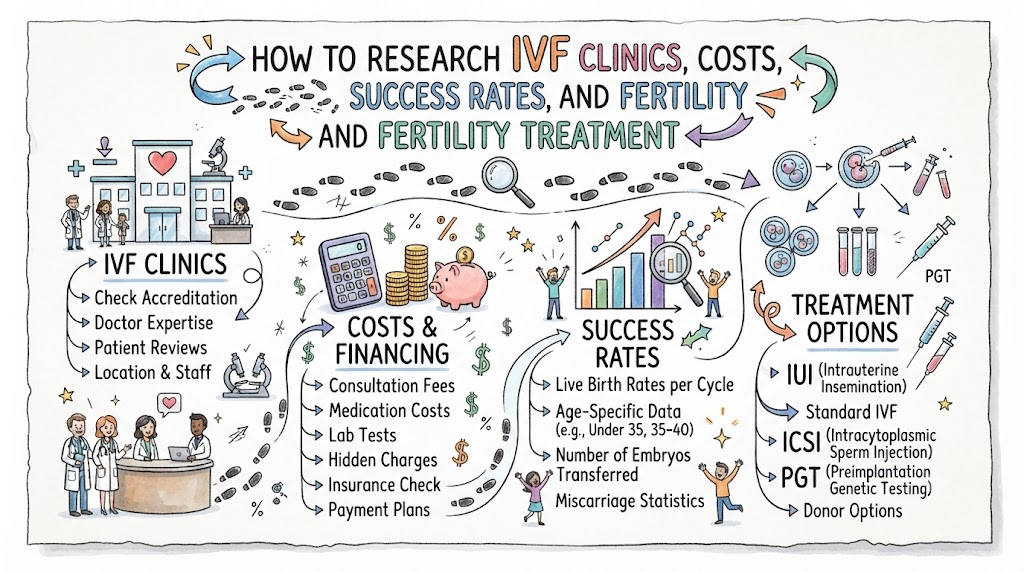
Introduction
Fertility treatment involves many choices and questions. People may search for IVF clinics, treatment prices, success rates, and nearby providers. They may also want to learn about IUI, ICSI, egg freezing, and other options.
Good research can make these topics easier to understand. It can also help people prepare useful questions for a fertility specialist. However, online information cannot show which treatment will suit one person.
IVF treatment cost can change based on the clinic, location, medicines, tests, and services. Success rates can also vary because clinics may use different measures. IVFHospitalsNow.com helps readers research fertility care, providers, treatment costs, and related topics.
The goal should always remain clear. Learn the facts, compare useful information, and discuss personal choices with a qualified healthcare professional.
Starting With the Basics: What Does an IVF Clinic Do?
An IVF clinic provides fertility care and assisted reproduction services. IVF means in vitro fertilization. The treatment allows fertilization to happen in a laboratory.
Many IVF clinics offer several services. These can include fertility testing, IVF, IUI, ICSI, egg freezing, sperm freezing, and embryo freezing.
Some clinics may also provide fertility medicines and reproductive consultations. Others may use separate laboratories for certain parts of treatment.
That difference matters when you compare providers. Always check which services a clinic provides directly.
You can also ask about laboratory facilities, specialist consultations, treatment support, and follow-up care. Clear answers can help you understand what each provider offers.
A Simple Look at the IVF Process
IVF usually involves several stages. Your fertility specialist will create a plan based on your individual situation.
The process often starts with a consultation and fertility testing. The care team may review medical history and perform different tests.
Doctors may then use medicines to stimulate the ovaries. These medicines can help the ovaries develop several eggs.
The clinic collects the eggs during egg retrieval. Laboratory staff then combine eggs and sperm to support fertilization.
Embryos can develop in the laboratory for a short period. The clinic may then transfer an embryo into the uterus.
Some embryos may remain frozen for possible future treatment. A pregnancy test follows later.
Not every treatment cycle follows exactly the same steps. Your specialist can explain the process planned for you.
What Goes Into IVF Treatment Cost?
Many people search for IVF treatment cost before contacting a clinic. However, no single price applies to every treatment plan.
The clinic location can affect the cost. Doctor visits, fertility testing, medicines, laboratory work, egg retrieval, and embryo transfer can also affect the total.
Additional services may create separate charges. These may include embryo freezing, storage, genetic testing, or further treatment cycles.
International patients may face more expenses. Flights, hotels, transport, insurance, and follow-up visits can increase the overall budget.
A starting price may not show the complete cost. Ask the provider for an itemized estimate.
You should also ask what the package does not include. This step can prevent confusion when you compare different providers.
Common IVF Cost Areas
| Cost Area | Possible Services | What Readers Should Check |
|---|---|---|
| Consultation | Specialist visits and treatment discussions | Ask about consultation fees |
| Testing | Blood tests, scans, and other assessments | Check which tests the package covers |
| Medicines | Fertility medicines and related drugs | Ask whether medicine costs sit outside the package |
| Egg retrieval | Egg collection and related care | Confirm procedure charges |
| Laboratory work | Fertilization and embryo culture | Check which laboratory services the package includes |
| Embryo transfer | Transfer procedure | Ask whether the clinic charges separately |
| Freezing | Egg or embryo freezing | Check storage terms and fees |
| Genetic testing | Embryo testing when applicable | Ask whether the service carries an extra cost |
| Additional cycles | Further treatment attempts | Check whether the quote covers one cycle or more |
| Travel | Flights, accommodation, and transport | Include these costs for overseas treatment |
Reading IVF Success Rates Without Getting Misled
Numbers can look simple, but IVF success rates need context. Different clinics may report different outcomes.
For example, a clinic may report a pregnancy rate. Another clinic may report a live birth rate. These numbers describe different outcomes.
Patient age can affect IVF results. Diagnosis, treatment history, egg factors, sperm factors, and embryo factors can also matter.
The treatment cycle itself can affect how a clinic reports results. Fresh and frozen embryo transfers may appear separately in some reports.
Patient groups also matter. Two clinics may treat different populations. Their published results may therefore differ.
Before comparing IVF success rates, ask the clinic:
- What outcome does the percentage measure?
- Does it show pregnancy or live birth?
- Does the figure apply per cycle?
- Which age groups does the data cover?
- Does the data include fresh transfers?
- Does it include frozen transfers?
- What period does the data cover?
- Which patient group does the data represent?
A published success rate cannot predict an individual’s result. Use the number as research information, not as a personal promise.
A Practical Method to Compare IVF Clinics
People often want to compare IVF clinics before making a consultation. A useful comparison should include more than price.
First, check the treatment services. Make sure each provider offers the services you want to discuss.
Next, review the cost structure. Ask about medicines, tests, laboratory work, storage, and extra procedures.
Then study the success-rate information. Look at the definition behind each number.
You should also review practical matters. Location, communication, appointment access, and follow-up support can affect the treatment experience.
Relevant licensing or accreditation information may also matter. Check current information from appropriate official or provider sources.
Online reviews can offer useful personal experiences. Still, reviews cannot replace medical information or professional advice.
Finding IVF Clinics Near Me
A search for “IVF clinics near me” can help you create a local shortlist. A nearby provider may reduce travel time for consultations and follow-up visits.
Distance can matter when treatment requires repeated appointments. However, the closest clinic may not offer every service.
Start by checking treatment availability. Then review specialist access, laboratory services, consultation schedules, and communication.
You can also ask how the clinic handles follow-up care. Find out who you can contact if you have questions between visits.
Useful points to compare include:
- Distance from home
- Appointment availability
- Fertility services
- Laboratory facilities
- Specialist access
- Follow-up arrangements
- Cost transparency
- Communication methods
- Travel requirements
Choose your shortlist based on relevant facts. Do not use distance as your only deciding factor.
Why Do People Explore IVF Treatment Abroad?
International fertility care can attract people for several reasons. Some people compare treatment costs. Others research services, availability, or local regulations.
However, treatment abroad requires extra planning. You may need several visits to the treatment location.
Travel expenses can include flights, accommodation, transport, meals, and insurance. You should include these costs when comparing providers.
Medical records also need attention. Ask the provider how you should share test results and treatment information.
Language support may matter as well. Clear communication can help you understand medical and financial information.
Follow-up care deserves special attention. Ask what happens after you return home.
Fertility laws can differ between countries. Rules may cover donor treatment, embryo storage, eligibility, and other services. Always verify current requirements before making travel plans.
Why Does IVF Cost by Country Differ?
Comparing IVF cost by country can help people understand broad price differences. However, country-level figures do not represent a guaranteed final cost.
Healthcare expenses differ between locations. Clinic fees, medicines, laboratory services, testing, and procedures can all affect the price.
Legal requirements can also affect available services. Donor-related treatment may involve different rules in different places.
International patients should add travel expenses to their budget. A lower clinic fee may not produce a lower overall trip cost.
Currency changes can also affect the final amount. Storage and follow-up care may create further expenses.
For these reasons, country comparisons should support research rather than replace a clinic quotation.
Ask each provider for current pricing and a clear list of included services.
A Clear Checklist for Comparing Providers
| Area | Questions to Ask | Information to Review |
|---|---|---|
| Treatment services | Which treatments do you offer? | IVF, ICSI, IUI, freezing, and related services |
| Medical team | Who provides the care? | Relevant qualifications and experience |
| Laboratory | Where does laboratory work happen? | Laboratory services and arrangements |
| Success rates | How do you calculate results? | Definitions, patient groups, and treatment periods |
| Treatment cost | What does the package include? | Tests, medicines, procedures, and laboratory work |
| Extra fees | Which services cost more? | Storage, testing, medicines, or additional cycles |
| Follow-up | How do you manage later care? | Visits and communication |
| Location | How often must patients visit? | Travel needs and appointment schedule |
| International support | What help do overseas patients receive? | Communication and travel information |
| Regulations | Which rules apply? | Current legal and eligibility requirements |
Understanding the Main Fertility Treatment Options
IVF represents only one part of fertility care. Several other treatment options exist.
Fertility medicines can support ovulation in some situations. IUI places prepared sperm inside the uterus.
IVF uses laboratory fertilization before an embryo transfer. ICSI uses a laboratory technique that places one sperm directly into an egg.
Egg freezing allows eggs to remain stored for possible future use. Sperm and embryos can also undergo freezing.
Some people may also explore donor-related options. Local laws and clinic policies can affect availability.
The right treatment depends on individual medical factors. A qualified fertility specialist can explain the options that fit the situation.
ICSI vs IVF: What Should You Know?
ICSI and standard IVF both involve laboratory fertility treatment. However, they use different fertilization methods.
Standard IVF places eggs and sperm together in a laboratory. Sperm then fertilizes an egg without direct injection.
ICSI takes a more direct approach. A laboratory specialist injects one sperm into an egg.
A fertility specialist may discuss ICSI for certain medical or treatment-related reasons. The decision depends on individual factors.
ICSI does not automatically offer better results for everyone. Patients should ask why a clinic recommends or discusses the procedure.
Cost can also differ. Ask whether ICSI forms part of the quoted IVF package or requires an additional fee.
Understanding Egg Freezing Cost
Egg freezing involves several stages. Each stage can affect the overall cost.
The process may begin with a consultation and fertility testing. Medicines and monitoring can add further expenses.
Egg retrieval creates another possible charge. Laboratory processing and freezing also form part of the treatment.
Storage can create ongoing fees. Future use may require additional treatment, such as fertilization and embryo transfer.
When comparing egg freezing cost, look beyond the initial procedure fee. Ask about storage and future treatment expenses.
Also remember that egg freezing does not guarantee a future pregnancy. A fertility specialist can explain the factors that affect future use.
Questions to Take to an IVF Clinic
A written question list can make consultations more useful. It can also help you compare answers from different providers.
Consider asking:
- Which fertility treatments do you offer?
- What does your quoted price include?
- Which services create additional fees?
- Does the price include fertility medicines?
- Which laboratory services do you provide?
- How do you calculate your success rates?
- Which patients do your statistics cover?
- What fertility tests may I need?
- What does embryo storage cost?
- What follow-up care do you provide?
- How do you support international patients?
- What cancellation or refund rules apply?
Ask the clinic to explain any medical term that you do not understand. Clear answers can help you make better research comparisons.
Common IVF Research Mistakes
Choosing a Clinic Only Because of Price
A low starting price may not include every service. Compare the full expected cost instead.
Trusting a Single Success Rate
One number cannot describe every patient. Check the definition, age group, treatment type, and reporting period.
Forgetting Medicine Costs
Medicines can add a significant part of the treatment budget. Ask whether the package includes them.
Assuming Every Clinic Offers the Same Services
Clinics can differ in treatments, laboratory facilities, and support. Check each provider separately.
Comparing Unrelated Success Numbers
Different clinics may use different measures. Compare numbers only after understanding their definitions.
Ignoring Fertility Laws
Rules can differ between locations. Check current requirements before planning treatment.
Forgetting Follow-Up Care
Treatment abroad can create follow-up challenges. Ask how the clinic manages care after you return home.
Depending Only on Reviews
Reviews can provide personal experiences. They cannot replace clinical information.
Accepting a Package Without an Itemized Quote
A package may exclude medicines, testing, storage, or other services. Ask for a detailed estimate.
Using Online Content as Personal Medical Advice
Online information provides general education. It cannot assess your individual health situation. Discuss personal treatment choices with a qualified professional.
The Role of IVFHospitalsNow.com in Fertility Research
Researching fertility care can involve many different topics. IVFHospitalsNow.com brings educational information together for people exploring these areas.
Readers can learn about IVF, ICSI, IUI, egg freezing, fertility testing, medicines, treatment costs, and success-rate interpretation.
The platform can also support provider research. Readers can explore available information about fertility clinics and treatment in different countries and locations.
This information can help people prepare for conversations with fertility professionals. It can also help them create useful questions before contacting a provider.
IVFHospitalsNow.com does not provide medical treatment. It does not replace a fertility specialist. Readers should use the platform as a research and education resource.
Create a Simple Fertility Research Plan
A step-by-step approach can make research easier to manage.
Learn → Identify Needs → Shortlist → Compare → Review Costs → Verify → Ask → Consult → Plan → Recheck
Learn
Understand basic terms before comparing providers. Start with IVF, IUI, ICSI, egg freezing, and fertility testing.
Identify Needs
Write down the topics you want to understand. Include treatment, cost, location, and follow-up questions.
Shortlist
Find providers that offer the services you want to research. Keep the list manageable.
Compare
Review services, cost details, success-rate definitions, and practical support.
Review Costs
Ask for itemized estimates. Include medicines, tests, laboratory work, storage, and possible additional treatment.
Verify
Check current provider information, licensing, or accreditation where relevant.
Ask
Prepare questions before your consultation. Ask the provider to explain unclear information.
Consult
Discuss your personal medical situation with a qualified fertility specialist.
Plan
Review appointments, travel, costs, records, and follow-up requirements.
Recheck
Confirm important information before making major decisions. Costs, services, and rules can change.
Examples of Better Fertility Research
Example: Comparing Local Clinics
Imagine two clinics offer IVF within a similar travel distance. One advertises a lower starting price.
Instead of choosing immediately, compare what each package includes. Check medicines, testing, laboratory services, embryo storage, and follow-up care.
This comparison can provide a clearer view of the expected costs.
Example: Researching Treatment Abroad
A person may find a lower advertised IVF price in another country. The person should calculate the full travel budget.
Flights, accommodation, transport, testing, and follow-up care can increase the final expense.
The person should also check current fertility laws before making arrangements.
Example: Comparing ICSI and IVF
Someone may read online claims that ICSI works better than standard IVF. Such claims may not apply to every situation.
The person can ask a fertility specialist why the clinic discusses ICSI. The specialist can explain the relevant medical and treatment factors.
Example: Planning Egg Freezing
A person may compare egg freezing prices by looking only at the initial procedure. However, storage and future treatment can create separate costs.
An itemized estimate can help show the wider financial picture.
Frequently Asked Questions About IVF and Fertility Care
1. What is an IVF clinic?
An IVF clinic provides fertility services and assisted reproduction care. It may offer IVF, ICSI, IUI, fertility testing, egg freezing, or embryo freezing. Each clinic has its own services and facilities. Some providers also use outside laboratories. Check the exact services before choosing a provider. A qualified fertility specialist can explain the options available for your situation.
2. How much does IVF treatment cost?
IVF treatment cost varies between providers and locations. The total may include consultations, tests, medicines, egg retrieval, laboratory work, and embryo transfer. Freezing and genetic testing may add separate costs. Additional treatment cycles can also increase expenses. International patients may need to budget for travel and accommodation. Request an itemized estimate before making financial plans.
3. What can affect IVF success rates?
Many factors can affect IVF success rates. These include age, diagnosis, treatment history, egg factors, sperm factors, and embryo factors. Clinics may also use different definitions when reporting results. Pregnancy rates and live birth rates measure different outcomes. Ask the clinic how it calculates its figures. Also check which patient group the data represents.
4. How should I compare IVF clinics?
Look at treatment services, specialist care, laboratory facilities, costs, success-rate reporting, and follow-up support. Ask what each package includes. Check possible extra fees for medicines, testing, storage, or additional treatment. You can also compare location and communication options. Do not choose a provider based only on price or online reviews.
5. What should I check when searching for IVF clinics near me?
Check the clinic’s distance, treatment options, specialist availability, laboratory services, and appointment access. Ask about follow-up visits and communication. A nearby clinic may offer fewer services than another provider. Consider travel time, cost transparency, and practical support as well. A local search should create a shortlist, not make the decision automatically.
6. Can IVF treatment abroad reduce costs?
Treatment abroad may have different clinic prices, but the total cost can include much more. Travel, accommodation, transport, testing, medicines, and follow-up care can add expenses. Local fertility laws can also affect available services. Compare the complete expected cost rather than the advertised clinic price. Verify current information before arranging international treatment.
7. Why does IVF cost by country vary?
Different countries have different healthcare costs. Clinic fees, medicines, laboratory services, testing, and legal requirements can affect prices. Travel costs also matter for international patients. Currency changes can influence the final budget. Country-level prices should therefore guide research rather than act as guaranteed quotes. Ask providers for current and detailed pricing.
8. What fertility treatment options can people explore?
People may research fertility medicines, IUI, IVF, ICSI, egg freezing, sperm freezing, and embryo freezing. Donor-related options may exist in locations where laws allow them. Each treatment has different uses and requirements. A fertility specialist can explain the available choices. Personal medical factors should guide treatment discussions rather than online comparisons alone.
9. What is the difference between ICSI and IVF?
Standard IVF places eggs and sperm together in a laboratory. ICSI involves injecting one sperm directly into an egg. Both methods support laboratory fertilization, but they use different techniques. ICSI does not automatically provide better results for everyone. A fertility specialist can explain why a clinic may consider it and whether it affects treatment costs.
10. What affects egg freezing cost?
Egg freezing cost can include consultation, fertility testing, medicines, monitoring, egg retrieval, laboratory work, and freezing. Storage may create an ongoing charge. Future use can also involve additional treatment costs. Prices vary between providers and locations. Ask for a complete written estimate. Make sure you understand both current and possible future expenses.
11. What questions should I ask an IVF clinic?
Ask about treatment options, total costs, additional fees, medicines, testing, laboratory services, and follow-up care. Ask how the clinic calculates success rates. You can also ask about embryo storage and international patient support. Written answers can help you compare providers. Ask the specialist to explain any medical information that seems unclear.
12. Can online fertility information replace a specialist?
No. Online resources can explain fertility topics and help people prepare questions. They cannot review your medical history or determine your personal treatment needs. A qualified fertility specialist can provide individual medical guidance. Use online information for education and research. Discuss personal treatment decisions with an appropriate healthcare professional.
Final Thoughts
Careful research can make fertility treatment easier to understand. Start by learning the basic differences between IVF, IUI, ICSI, egg freezing, and other options.
When you compare IVF clinics, look beyond the starting price. Review services, medicines, testing, laboratory work, storage, follow-up care, and possible extra charges.
Success rates also need context. Ask what each statistic measures and which patient group it covers.
People considering IVF treatment abroad should review travel costs and current local rules. IVFHospitalsNow.com can help readers explore fertility information and provider details.
Use research to prepare better questions. Then rely on qualified fertility professionals for personal medical guidance.
Leave a Reply