Financial Clarity for Everyday Life: Manage Expenses, Plan Savings, and Avoid Money Stress

October 10, 2026 · 6 reads
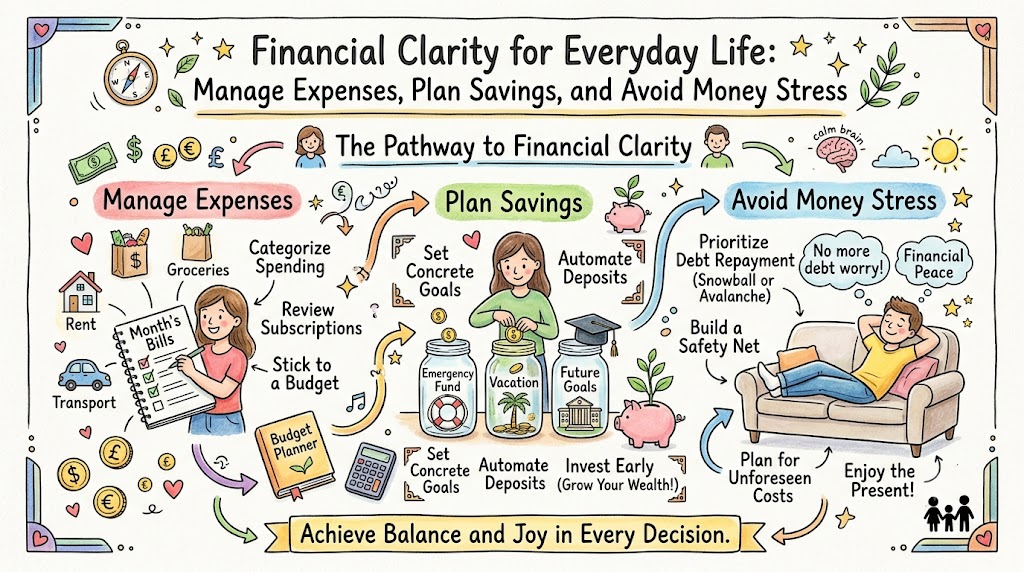
Introduction
Unexpected bills, rising prices, and frequent digital payments can make personal finance difficult to manage. You may earn a steady income yet struggle to understand why little money remains at the end of each month. Often, the problem comes from scattered spending records and a lack of clear financial priorities.
A practical money management system can help you change this pattern. By reviewing your expenses, planning upcoming payments, and setting realistic savings goals, you can make better use of your income.
This guide explains how to organise personal finances, monitor recurring charges, control unnecessary spending, and prepare for financial emergencies. It also covers useful digital tools and common mistakes that can weaken your budget.
1. Start With a Monthly Financial Checkup
Before changing your spending habits, examine your current financial position. Gather your bank statements, payment histories, salary details, bills, and debt records.
Your first goal is to understand three things:
- How much money you receive each month.
- How much money you spend.
- How much money remains after your commitments.
Use your take-home income as the starting point. If your earnings change each month, estimate them conservatively and prepare for weaker months.
Next, list your regular obligations. Include rent, groceries, electricity, transport, education, healthcare, insurance, and loan payments. Add recurring digital services and predictable annual bills.
This review can reveal problems that a bank balance alone cannot explain. It also gives you a reliable starting point for your budget.
Calculate Your Monthly Financial Gap
Use this formula:
Monthly surplus or shortfall = Monthly income − Monthly expenses
Consider a hypothetical example:
| Financial item | Amount |
|---|---|
| Monthly income | ₹38,000 |
| Household expenses | ₹17,000 |
| Transport and utilities | ₹4,000 |
| Loan payments | ₹6,000 |
| Personal spending | ₹5,000 |
| Subscriptions and memberships | ₹1,000 |
| Total expenses | ₹33,000 |
| Remaining balance | ₹5,000 |
This example leaves ₹5,000 after the listed expenses. You could allocate it toward savings, future bills, or additional debt repayment, depending on your circumstances.
Check for missing expenses before making that decision.
2. Turn Daily Transactions Into Useful Information
A financial review works only when your records reflect your actual spending. Forgotten cash purchases, duplicate entries, and missing bills can produce misleading totals.
Choose a tracking method that fits your routine. A notebook, spreadsheet, or digital expense tracker can all work.
Record the date, amount, category, and purpose of each transaction. For digital purchases, use bank statements and payment histories to check your entries. Record cash expenses separately.
Organise Transactions by Purpose
Create a manageable set of categories:
- Household essentials
- Transport and travel
- Healthcare and education
- Debt and insurance payments
- Shopping and entertainment
- Subscriptions and memberships
- Savings and financial goals
Adjust these groups to match your needs. Freelancers may want separate business expense categories, while families may need dedicated education or childcare categories.
Avoid making the system too complicated. The goal is to understand spending, not to spend hours maintaining records.
Review the Data Regularly
Check your transactions weekly and correct any errors. At the end of the month, calculate the total for each category.
Compare these figures with your budget. If a category exceeds its limit, investigate the reason before deciding what to change.
3. Build a Budget Around Your Priorities
A budget helps you assign money to important needs before optional purchases consume it. It should reflect your actual living costs rather than an ideal spending pattern.
Start with essential bills and required financial commitments. Next, decide how much you can save and how much you can spend on personal activities.
Use the 50/30/20 Rule as a Reference
The 50/30/20 method offers a simple starting point:
- 50% for needs: Housing, groceries, utilities, and necessary transport.
- 30% for wants: Dining, shopping, entertainment, and hobbies.
- 20% for savings and debt goals: Emergency reserves, future plans, and eligible additional debt repayments.
Suppose your monthly take-home income is ₹38,000. The method would suggest ₹19,000 for needs, ₹11,400 for wants, and ₹7,600 for savings and debt goals.
These amounts are guidelines, not fixed rules. If essential costs consume more than half your income, adjust the other categories to fit your circumstances.
Give Irregular Expenses Their Own Place
Many budgets fail because people focus only on monthly bills. Annual insurance premiums, vehicle repairs, school expenses, and other predictable costs also need attention.
Suppose you expect an annual expense of ₹15,000. Divide it by 12 to get a monthly planning target of ₹1,250.
Setting aside that amount gradually can help you prepare for the bill. You must still account for the actual due date and keep enough money available when payment becomes necessary.
4. Identify Spending Habits That Reduce Your Savings
Small expenses can become significant when they happen frequently. Reviewing these habits can help you find savings opportunities without cutting every enjoyable activity.
Imagine that you spend ₹180 on convenience purchases on 15 days each month.
₹180 × 15 = ₹2,700 per month.
If the same pattern continues for a full year, the total reaches ₹32,400.
This hypothetical example assumes consistent spending. Your actual total may differ, but the calculation shows why frequent purchases deserve attention.
Examine Your Flexible Expenses
Look for spending patterns such as:
- Frequent food delivery orders.
- Impulse purchases during online sales.
- Repeated convenience fees.
- Unused digital services.
- Overlapping memberships.
- Purchases made without comparing alternatives.
Choose one category and decide whether a reasonable change could improve your financial position.
For example, you might plan meals before grocery shopping or set a weekly limit for optional purchases. Keep essential healthcare, nutrition, and necessary household spending protected.
5. Manage Subscriptions Before They Become a Burden
Recurring payments can make financial planning difficult because they continue automatically. You may stop using a service but still pay for it every month.
Create a subscription register with the service name, cost, billing frequency, renewal date, and cancellation conditions.
Include entertainment services, cloud storage, software plans, online memberships, and other regular charges.
Calculate the Annual Commitment
Suppose a service costs ₹399 per month.
₹399 × 12 = ₹4,788 per year.
If you maintain three subscriptions at that price, your annual total becomes ₹14,364.
This calculation assumes that all three services remain active for 12 months and their prices do not change.
Review each service individually. Cancel unused plans or choose cheaper alternatives when they meet your needs.
Avoid Unwanted Automatic Renewals
Free trials sometimes convert into paid plans when the trial period ends. Providers may also require cancellation before a specific renewal date.
To avoid surprises:
- Record each trial’s end date.
- Review the cancellation policy.
- Check upcoming renewal charges.
- Cancel unwanted services before the applicable deadline.
- Review later statements for unexpected payments.
Keep cancellation confirmations when available. If a provider charges you incorrectly, contact it through an appropriate official channel.
6. Prepare for Emergencies Before They Happen
An emergency fund helps you handle unexpected expenses without immediately relying on borrowing. It can support essential costs during temporary income loss or urgent repairs.
Your target should reflect your financial responsibilities, not someone else’s savings goal.
Estimate Your Emergency Fund
Many people aim to save three to six months of essential expenses.
Suppose your essential monthly costs total ₹21,000.
- Three months: ₹63,000
- Six months: ₹1,26,000
These figures are planning examples rather than universal requirements. You may need a different amount depending on job stability, dependants, debt, and other resources.
Start with a smaller target if necessary. Build the reserve gradually while maintaining your essential payments.
Keep Emergency Savings Accessible
Choose an appropriate place for emergency money based on access, safety, and your needs. Avoid treating this reserve as money for routine shopping or planned entertainment.
Review the target when your income or essential expenses change.
7. Use Financial Tools to Improve Visibility
Digital tools can help you organise spending and review financial commitments. However, different tools offer different capabilities, so check the available features before relying on one.
An expense tracker may record transactions and summarise spending categories. A budget planner may compare planned amounts with actual costs. A recurring payment tracker may help you monitor subscriptions and renewal dates.
Compare Tools Using Practical Criteria
Ease of use: Can you record and review transactions without unnecessary effort?
Category reports: Can you see how much you spend on different needs?
Recurring expense management: Can you record renewal dates and payment amounts?
Export options: Can you download your records for further review?
Privacy practices: Does the provider explain how it handles financial information?
A spreadsheet may suit people who prefer manual control. An application may suit people who want more convenience.
If you import transactions from a CSV file, check the dates, amounts, and categories. Incorrect formatting or duplicate entries can distort the results.
8. Protect Your Financial Data and Digital Payments
Managing money also means protecting your accounts from fraud and unauthorised access.
Scammers may impersonate bank employees, create fake customer support numbers, or send misleading payment requests. They may pressure you to act quickly or disclose confidential information.
Follow these precautions:
- Never share your UPI PIN, banking password, or OTP.
- Verify unexpected payment requests before approving them.
- Avoid installing remote-access applications at an unknown person’s request.
- Use official channels when contacting your bank.
- Review transaction alerts and account statements regularly.
Remember that you do not need to reveal your UPI PIN to receive money.
If you notice a suspicious transaction, contact your bank or payment provider promptly. Use the appropriate official reporting channels and follow their instructions.
9. Common Mistakes That Weaken Financial Planning
Ignoring Small Transactions
Frequent small purchases can distort your monthly totals when you fail to record them. Track cash and digital payments consistently.
Forgetting Annual Commitments
Insurance premiums and other annual bills can create sudden pressure. Estimate predictable costs and prepare for their due dates.
Setting Unrealistic Savings Targets
A target that leaves too little for essential needs can lead to borrowing later. Choose a sustainable amount and increase it when possible.
Counting Account Transfers as Expenses
Moving money between your own accounts does not automatically represent spending. Track transfers separately to avoid double-counting.
Relying on Unchecked Reports
Automated reports may misclassify purchases or miss transactions. Compare summaries with source records before making financial decisions.
Ignoring Changes in Income
A budget based on an old salary or previous spending pattern may no longer work. Review your plan whenever your income or responsibilities change.
10. Important Considerations for Financial Health
Expense tracking can improve financial awareness, but it cannot remove every financial risk.
The accuracy of your results depends on complete records and correct categories. If you forget cash purchases or enter transactions twice, your reports may misrepresent your spending.
Privacy also matters. Financial applications may collect information about your habits and commitments. Review their permissions and data policies before connecting accounts or importing sensitive records.
Keep personal and business finances separate when possible. This practice makes it easier to understand household spending and business operating costs.
Finally, remember that a budget or financial health score offers only part of the picture. Consider debt obligations, savings, income stability, recurring payments, and future needs before making major decisions.
11. How MoneyVoid.com Relates to Financial Awareness
MoneyVoid.com focuses on personal expense analysis, subscription management, budget planning, startup finances, SaaS spending, and financial risk awareness.
These areas address practical problems faced by households and businesses. Individuals need to understand where their money goes, while founders and finance teams need visibility into recurring operating costs.
MoneyVoid.com is being developed around these needs. Verify current availability before assuming a particular tool or feature is ready to use.
Regardless of the platform you choose, accurate information and regular reviews remain essential for informed financial decisions.
Frequently Asked Questions (FAQs)
1. How can I improve my monthly money management?
Record income and expenses, organise transactions into categories, and review your budget weekly. Identify the main reasons for overspending and make realistic changes to flexible costs.
2. What should I include in a household budget?
Include housing, groceries, utilities, transport, healthcare, education, debt payments, insurance, subscriptions, savings, and irregular expenses. Adjust the categories to reflect your family’s needs.
3. How do I calculate my monthly savings?
Subtract total monthly expenses from total monthly income. If you earn ₹38,000 and spend ₹33,000, your remaining balance is ₹5,000, assuming you recorded all relevant expenses.
4. Is the 50/30/20 budgeting rule compulsory?
No. It is a general guideline that helps people organise income. Adjust the percentages when housing costs, family responsibilities, debt, or other essential expenses require a different allocation.
5. How can I reduce unnecessary spending without affecting my lifestyle?
Review frequent purchases, unused subscriptions, and overlapping services. Focus on expenses that provide limited value. You can reduce waste while keeping the activities and services that genuinely matter to you.
6. How much should I save for emergencies?
Many people work toward three to six months of essential expenses. Your target depends on income stability, dependants, debt, and access to other resources. Start with a manageable amount and build gradually.
7. How can I monitor subscription renewals?
Create a list of active services with their costs, billing dates, and cancellation conditions. Review the list regularly and cancel unwanted plans before the relevant renewal deadline.
8. Can a spreadsheet work as an expense tracker?
Yes. A spreadsheet can record transactions, group spending categories, and calculate monthly totals. Check entries for missing payments and duplicates to keep your records accurate.
9. What should freelancers consider when planning expenses?
Freelancers should estimate income conservatively, separate business and personal costs, prepare for applicable taxes, and maintain reserves for weaker months. They should also account for irregular client payments.
10. What should I do if I cannot meet my loan payments?
Review your essential expenses and contact the lender promptly to discuss available options. Avoid ignoring missed payments. Consider qualified financial counselling if debt pressure continues.
11. How can I protect my money from UPI fraud?
Never share your UPI PIN or OTP. Verify payment requests and contact your bank through official channels when something seems suspicious. Report suspected unauthorised transactions promptly.
12. Will an expense management tool automatically improve my finances?
No. A tool can organise information and highlight spending patterns, but you must review the results and make appropriate decisions. Financial outcomes depend on your income, commitments, record accuracy, and habits.
Conclusion
Financial awareness begins when you stop guessing and start reviewing your money carefully. A practical budget, accurate records, subscription checks, and emergency savings can help you prepare for everyday expenses and unexpected changes.
Start by reviewing one month’s transactions and identifying your biggest spending categories. Use those findings to make realistic adjustments, then repeat the process regularly. Consistent financial habits can help you build a clearer and more manageable plan for the future.
Leave a Reply