Understanding Global Mobile Networks: MCC, MNC, and PLMN Lookup Guide

October 24, 2026 · 21 reads
Introduction
Mobile networks help people stay connected wherever they travel. They support phone calls, mobile data, messaging, and many digital services. Behind these connections, telecom systems use special codes to identify mobile networks.
Three important terms in this process are MCC, MNC, and PLMN. These identifiers help distinguish networks and organize telecom information across countries. They also support network research, mobile connectivity analysis, and telecom data management.
However, understanding these codes can feel confusing at first. Each identifier serves a different purpose, and small formatting mistakes can lead to incorrect results.
eSIMGlobo helps users explore global telecom providers and research mobile network identifiers. Visit esimglobo.com/ to discover information about mobile network operators, network codes, and telecom providers.
This guide explains how these identifiers work, how to look them up, and how to use their information correctly.
Understanding the Basics of Mobile Network Identification
Mobile network identification helps telecom systems distinguish one network from another. It also gives researchers a standard way to organize network information.
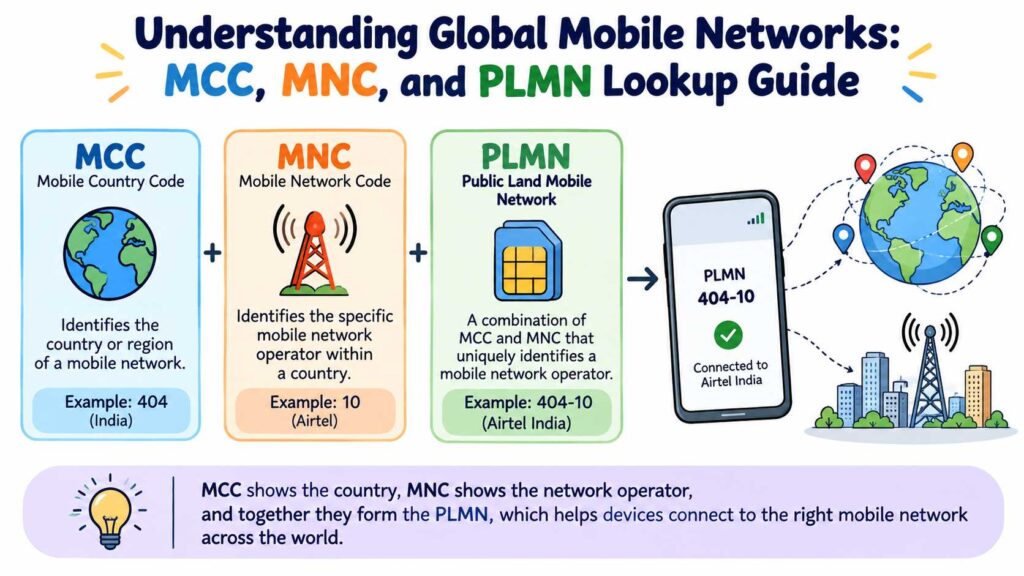
MCC and MNC work together to identify a mobile network. Their combined identifier is commonly known as a PLMN identifier.
Although these terms often appear together, they do not mean the same thing.
Mobile Country Code: Identifying the Country
A Mobile Country Code, or MCC, is a three-digit number used in mobile network identification.
The code identifies the country or applicable numbering scope associated with a network. Systems use it together with the MNC to identify a particular network.
An MCC is different from an international telephone dialing code. A telephone code helps route calls to a destination, while an MCC helps identify a mobile network.
For telecom researchers, MCC information provides a useful starting point when examining network assignments across countries.
Mobile Network Code: Identifying the Network
A Mobile Network Code, or MNC, identifies a mobile network within an MCC scope.
An MNC may contain two or three digits, depending on the applicable numbering plan. Users must preserve the correct number of digits when recording or searching these identifiers.
For example, 310-260 illustrates a combined MCC-MNC identifier. In this example, 310 represents the MCC, while 260 represents the MNC.
The example explains the identifier’s structure. Users should verify the current assignment before associating the code with a specific operator.
Public Land Mobile Network: Combining the Codes
A Public Land Mobile Network, or PLMN, provides mobile communication services through a land-based network.
A PLMN identifier combines the MCC and MNC. This combination helps mobile systems distinguish networks during procedures such as network selection and registration.
You may see a PLMN identifier written as 310-260 or 310260. The second format removes the separator, so readers must know the correct digit lengths.
A PLMN identifier does not reveal every detail about a network. It cannot independently confirm coverage, commercial activity, roaming access, or device compatibility.
MCC vs. MNC vs. PLMN: Key Differences
Understanding the differences between these terms makes telecom research easier.
| Identifier | Full Name | Main Purpose | Typical Format |
|---|---|---|---|
| MCC | Mobile Country Code | Identifies a country or applicable numbering scope | Three digits |
| MNC | Mobile Network Code | Distinguishes a network within an MCC scope | Two or three digits |
| PLMN | Public Land Mobile Network identifier | Combines MCC and MNC to identify a network | MCC + MNC |
Each identifier provides a different piece of information. The MCC establishes the numbering context, the MNC identifies the network, and the PLMN combines both values.
Telecom professionals should understand these differences before analyzing network records or building lookup applications.
Why Mobile Network Code Lookup Matters
MCC and MNC lookup connects numeric identifiers with available network assignment information. It helps users investigate unfamiliar codes without searching through every telecom document manually.
Different users can benefit from this process in different ways.
Helps Telecom Researchers Find Network Information
Telecom researchers often compare mobile network assignments across countries. They may need to identify an assignee, investigate changes, or organize network information for a report.
A searchable directory makes this process easier. It can also help researchers identify records that require further investigation.
However, a directory result should not replace official assignment records when accuracy matters.
Supports Software Development
Developers sometimes work with PLMN identifiers in telecom applications and network-related datasets.
A lookup system can connect a code with an available country or assignment record. Applications can then display this information in a readable format.
Developers should validate input, preserve leading zeros, and handle missing records carefully. They should never invent an operator name when a lookup returns no reliable match.
Improves Connectivity Research
Network identifiers can help researchers investigate mobile connectivity and roaming arrangements.
For example, a researcher may use an MCC-MNC pair to identify a network mentioned in technical data. The researcher can then investigate whether the network has a relevant relationship with a mobile service provider.
Still, an identifier alone does not prove that a roaming agreement exists. Current agreements, device support, subscription settings, and network availability also affect connectivity.
Helps Maintain Telecom Databases
Telecom companies and research teams often manage large collections of network records.
A consistent lookup source can help them compare identifiers, review missing information, and detect possible data errors.
Teams should also record where each important assignment came from. Keeping the source and review date makes future verification easier.
How to Find an MCC and MNC Code
Finding a mobile network identifier involves more than entering a number into a search box. You should also confirm that the result matches the information you need.
Follow these practical steps.
Step 1: Choose a Suitable Directory
Start with a telecom directory that explains its coverage and data sources.
eSIMGlobo provides a starting point for researching global telecom providers and mobile network identifiers. You can visit to explore the available directory information.
Before relying on a result, check whether the directory explains how it handles official assignments, historical records, and uncertain classifications.
Step 2: Search Using Available Information
Choose your search method based on what you already know.
You might know the country, the operator’s name, or the complete MCC-MNC identifier. Use the available search filters to narrow your results.
Not every directory supports the same search options. Confirm the available features instead of assuming that all search methods are supported.
Step 3: Examine the Record
Review the returned information carefully.
Look for the MCC, MNC, country, recorded assignee, and any available source references. Check whether the record describes a current assignment or a historical entry.
Do not rely only on a familiar commercial brand name. A company may have multiple assignments, and its legal name may differ from its consumer-facing name.
Step 4: Verify Important Details
Check authoritative records when you need reliable confirmation.
The International Telecommunication Union provides international telecom numbering and identification resources. Relevant national telecom authorities may also publish assignment information.
Compare the identifier and recorded organization with the available evidence. If the records disagree, investigate the difference instead of selecting one without explanation.
Step 5: Use the Result Carefully
After finding a matching record, determine what it actually confirms.
The record may identify an assignment without proving that the organization currently offers commercial mobile services. You may need additional information to establish its operating role or relationship with a particular brand.
This distinction is especially important when using telecom data for business decisions or software applications.
What Information Should a Telecom Directory Include?
A useful mobile network operator directory should provide enough detail to help users understand each record.
However, some directories may contain incomplete information. Missing fields should not automatically suggest that a record is incorrect.
The following table explains common fields.
| Field | Description | Why It Matters |
|---|---|---|
| Country | Country or numbering scope linked to the record | Helps narrow the search |
| MCC | Mobile Country Code | Identifies the relevant numbering scope |
| MNC | Mobile Network Code | Distinguishes the network within that scope |
| PLMN | Combined MCC-MNC identifier | Provides the complete network identifier |
| Assignee | Organization recorded against the assignment | Helps identify the responsible entity |
| Brand | Commercial name, when documented | Connects the assignment with a consumer-facing brand |
| Source | Reference supporting the assignment | Helps verify the information |
| Date | Date associated with the record or update | Provides useful historical context |
| Provider classification | Verified business or network role, when available | Helps distinguish different provider types |
These fields help users interpret network records more accurately.
A directory should distinguish verified information from uncertain details. This practice reduces the risk of incorrect assumptions.
Understanding MNOs, MVNOs, and eSIM Providers
Telecom directories may contain organizations with different business models. A network-code assignment does not automatically tell you which model an organization follows.
Understanding these differences helps users interpret directory results correctly.
Mobile Network Operators
A Mobile Network Operator, or MNO, operates mobile network infrastructure and provides mobile network services.
Its operations may include radio access equipment, network management systems, and other infrastructure required to deliver connectivity.
An MNO may hold one or more network-code assignments. However, researchers should verify the relationship between the assignment holder and the current operating company.
Mobile Virtual Network Operators
A Mobile Virtual Network Operator, or MVNO, provides mobile services using another operator’s network infrastructure.
An MVNO may manage its own brand, customers, and service plans. However, its technical and commercial arrangements depend on its agreements with the underlying network operator.
Some MVNOs may hold relevant network identifiers. Others may operate without their own MCC-MNC assignments.
Therefore, an MCC-MNC directory alone cannot identify every MVNO in a country.
eSIM Providers
An eSIM provider offers digital mobile connectivity plans for compatible devices.
Some providers work with multiple underlying network operators. Others sell plans supplied through wholesale partners or connectivity platforms.
The provider’s brand may differ from the network that supplies mobile access. An eSIM brand also does not necessarily have its own MCC-MNC assignment.
To identify the underlying network, review the provider’s current plan details and supporting documentation.
How MCC and MNC Lookup Supports eSIM Research
eSIM technology allows compatible devices to download mobile subscription profiles without inserting a physical SIM card.
Although the subscription format differs, mobile network identification remains important. MCC and MNC information can help researchers investigate which networks appear in connection records.
However, these identifiers provide only part of the information needed to understand an eSIM service.
Researching Underlying Network Operators
An eSIM plan may use different operators across countries or regions.
Researchers can examine network identifiers to investigate the operators associated with those records. They should then compare the results with the provider’s current plan information.
A directory lookup alone cannot confirm which network a particular plan will use in every location.
Exploring Connectivity by Country
A country-based directory can help users investigate mobile network assignments in their destination.
This information can support early research when comparing connectivity options. However, network availability varies by location, infrastructure, and local operating conditions.
Users should check current coverage information before relying on a network for travel or work.
Checking Device Support
Device compatibility depends on more than a network identifier.
A device must support the relevant frequency bands and network technologies. The subscription and provider must also support the device and service configuration.
Therefore, a matching MCC-MNC record does not guarantee that an eSIM will work on a particular phone.
Understanding Roaming
Some eSIM plans depend on roaming agreements with partner operators.
Network identifiers can help researchers investigate the networks involved. However, current agreements and plan restrictions determine whether a subscriber can access a particular network.
Always combine identifier research with current provider documentation.
MCC MNC Lookup API: A Guide for Developers
An MCC-MNC lookup API allows software to request network information through a defined interface.
Developers may use an API to retrieve assignment records, enrich datasets, or support network research features. However, they should first confirm that the selected service actually offers a documented API.
A website directory does not automatically provide API access.
Common Uses for a Lookup API
Developers can use a lookup API for several purposes.
- Network identification: Match an MCC-MNC pair with an available assignment record.
- Data enrichment: Add country or assignee information to an existing dataset.
- Input validation: Check whether a code follows the expected format and matches an available record.
- Telecom research: Build search features for mobile network information.
- Reporting: Combine network records with other datasets for analysis.
These are general use cases. Actual features depend on the API provider.
Data Quality and Updates
An API must provide clear information about its data sources and update process.
Developers should check coverage, field definitions, historical records, and the handling of unknown identifiers. They should also confirm whether the service permits the intended use.
Preserve MCC and MNC values in their original format. Treating them as ordinary numbers can remove leading zeros or create incorrect identifiers.
Handling Errors
A reliable application should handle invalid input and missing records.
It should also manage timeouts, incomplete responses, and outdated cached information. When a lookup fails, the application should return a clear result instead of guessing the operator.
These safeguards help protect data quality across connected systems.
Choosing the Right API
Compare the following factors before selecting a lookup service.
| Factor | What to Review |
|---|---|
| Data sources | Does the provider explain its records’ origins? |
| Country coverage | Does it cover your target countries? |
| Identifier support | Does it support the codes your application needs? |
| Update policy | Does it explain when records change? |
| Documentation | Does it explain requests, responses, and errors? |
| Access requirements | Does it require an account or API key? |
| Usage rights | Do the terms support your intended use? |
| Reliability | Does it explain service limits and failure handling? |
Choose a service based on your actual needs, not simply its advertised record count.
Common Mistakes When Looking Up Network Codes
Small mistakes can produce misleading telecom research results.
Confusing Network Assignments With Commercial Services
A network-code assignment identifies a recorded assignee. It does not automatically confirm that the organization currently operates a consumer mobile service.
Check current business and network information before making that claim.
Losing Leading Zeros
MNC values may contain two or three digits.
If software removes a leading zero, the resulting identifier may no longer match the original record. Store identifiers as strings and preserve their original digit lengths.
Assuming Every eSIM Brand Owns a Network
An eSIM provider may rely on partner networks rather than operate its own mobile infrastructure.
Investigate the underlying network operator instead of assuming that the retail brand holds an assignment.
Relying on Old Records
Telecom assignments and commercial relationships may change.
Historical records can support research, but they should not automatically serve as current operational information. Check relevant dates and available update records.
Treating a Code as Proof of Coverage
An MCC-MNC identifier does not confirm signal availability or service quality.
Coverage, device compatibility, network technology, and subscription terms all affect connectivity. Verify these factors separately.
Guessing Missing Information
Some records may lack enough evidence to support a clear conclusion.
Do not guess an operator’s name or business category. Mark the information as unknown until reliable evidence becomes available.
How eSIMGlobo Supports Telecom Research
eSIMGlobo is an independent global telecom provider directory. It helps users discover and research mobile network operators, network identifiers, and telecom provider information.
The platform supports research into MCC-MNC assignments and related network information. Its value depends on the records available for each country and the evidence supporting individual entries.
Useful for Telecom Researchers
Researchers can use a directory to explore network assignments across countries.
This can help them organize research and identify records that need further verification. Official assignment documents remain important when a project requires authoritative confirmation.
Useful for Developers
Developers can consult network directories when researching mobile network identification.
Before building an integration, they should confirm the available features, data access methods, and usage terms. They should not assume that every directory offers an API or downloadable dataset.
Useful for Travelers
Travelers can investigate network information associated with a destination.
This research can help them understand the operators mentioned in connectivity documentation. However, they should confirm current coverage and roaming details with their mobile or eSIM provider.
Useful for Telecom Businesses
Telecom businesses may use assignment information to investigate network relationships and organize reference data.
They should keep official assignment records separate from commercial provider classifications. This helps prevent unsupported assumptions from entering business reports.
Best Practices for Managing Mobile Network Data
A reliable telecom database needs a clear process for collecting, reviewing, and updating records.
Keep Source Information
Record the source associated with each important assignment.
Where possible, include the publication date and the date your team reviewed the record. These details help future users understand the information’s history.
Separate Technical and Commercial Records
Keep network-code assignments separate from brand names and commercial service details.
A recorded assignee may differ from the brand that sells services to customers. Store the relationship separately when reliable evidence supports it.
Track Changes
Maintain a record of important updates.
Do not overwrite historical information when it matters to your research. A change log can help explain differences between older reports and current records.
Mark Uncertain Data
Use clear labels when a provider relationship remains unresolved.
Do not classify an organization as an MNO or MVNO based only on its network identifier. Verify the organization’s actual role first.
Review Important Records Regularly
Set a review schedule that matches your project’s needs.
Prioritize records used in customer-facing systems, technical integrations, and business decisions. Verify important changes before updating production data.
The Future of Mobile Network Directories
Mobile connectivity includes traditional operators, virtual networks, roaming partners, and digital connectivity providers.
As these relationships grow more complex, users need better ways to distinguish network assignments from commercial services. A single provider name may not explain every network relationship behind a connectivity product.
Clear data sources, consistent identifiers, and transparent update records can help improve telecom research.
Automation may also help teams validate formats and identify possible changes. However, automated tools should not replace human verification when records remain ambiguous.
For eSIM research, users need to connect provider information with the networks a plan can actually access. This requires network identifiers, current plan documentation, and relevant operational evidence.
The main goal is to make telecom information easier to find, understand, and verify.
Frequently Asked Questions
1. What is MCC-MNC lookup?
MCC-MNC lookup helps users identify a mobile network assignment associated with a Mobile Country Code and Mobile Network Code. Depending on the directory, users may search by code, country, or provider name.
2. What does MCC mean?
MCC stands for Mobile Country Code. It is a three-digit identifier used in mobile network identification.
3. What does MNC mean?
MNC stands for Mobile Network Code. It distinguishes a mobile network within an MCC scope and may contain two or three digits.
4. What is a PLMN identifier?
A PLMN identifier combines the MCC and MNC to identify a Public Land Mobile Network.
5. Where can I find mobile network codes by country?
You can explore a global telecom directory such as eSIMGlobo. Verify important assignments with authoritative sources before using them for technical or business decisions.
6. Are MCC and MNC the same as telephone country codes?
No. Telephone country codes support international call routing. MCC and MNC identify mobile networks.
7. Does every mobile provider have its own MCC-MNC assignment?
No. Some commercial providers use another operator’s infrastructure and do not have their own assignment.
8. Can MCC-MNC lookup confirm eSIM compatibility?
No. It can help identify a network, but compatibility also depends on device support, frequency bands, service settings, and provider restrictions.
9. What should developers check before using an MCC-MNC API?
Developers should review data sources, coverage, update policies, documentation, access requirements, and usage terms. They should also confirm that the API supports the required identifier formats.
10. How often should telecom databases be updated?
The appropriate schedule depends on the project’s needs and the source’s update process. Teams should review official assignment information regularly and verify important changes before relying on them.
Conclusion
MCC, MNC, and PLMN identifiers help users understand how mobile networks identify themselves. These codes support telecom research, network analysis, software development, and connectivity investigations.However, accurate results require careful verification. Users must preserve identifier formats, check reliable sources, and distinguish network assignments from commercial services.eSIMGlobo offers a starting point for exploring global telecom providers and mobile network identifiers. Visit esimglobo.com/ to begin your research and learn more about the information available in its directory.
Leave a Reply